Enterprise servers increasingly depend on high CPU throughput for virtualization, databases, analytics, scientific computing, application platforms, and other workloads that can use many processor cores simultaneously.
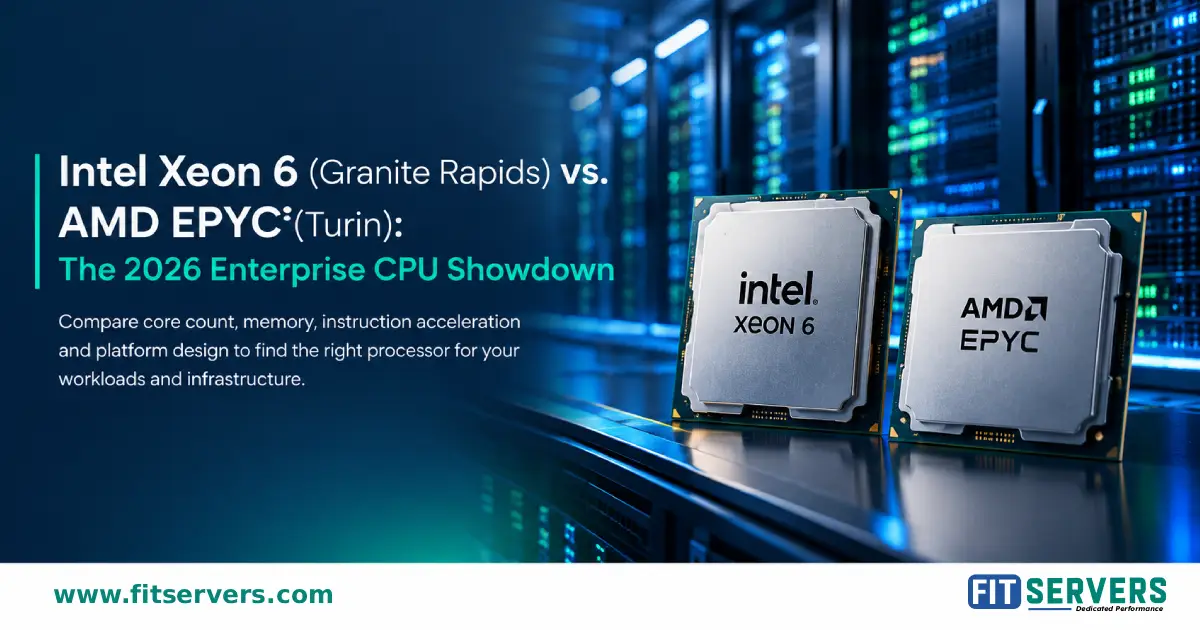
In 2026, two major platforms competing in this space are Intel Xeon 6 with Performance-cores (Granite Rapids) and AMD EPYC 9005 Series (Turin). Both platforms target demanding data-center workloads, but they take different approaches to core count, memory, instruction acceleration, and platform design. The important question is not simply which processor has more cores. The better comparison is how each architecture matches the workload, software, memory requirements, and server configuration.
01 Specs at a Glance
Before diving into architecture, here is how the top-end specifications stack up on paper for both processor families.
| Feature | Intel Xeon 6 P-core | AMD EPYC 9005 |
|---|---|---|
| Architecture | Granite Rapids | Zen 5 / Zen 5c |
| Max cores / socket | Up to 128 P-cores | Up to 192 cores |
| Max threads / socket | Up to 256 | Up to 384 |
| Memory | DDR5, MRDIMM support on applicable platforms | DDR5 |
| Memory channels | Platform/model dependent | Up to 12 |
| PCIe | PCIe 5.0 | PCIe 5.0 |
| AVX-512 | Yes | Yes |
| Hyper-Threading | Available on P-core models | Available |
| AI acceleration | Intel AMX on P-core Xeon 6 | Varies by model |
| Primary strength | High per-core performance, vector/AI acceleration, scalable compute | High core density and multi-threaded throughput |
Intel specifies up to 128 P-cores per socket for Xeon 6 P-core processors, along with AVX-512 and Intel AMX. AMD's EPYC 9005 family scales to 192 cores and 384 threads, depending on model. Note: These specifications should not be interpreted as a universal benchmark result.
02 Core Count: AMD Has the Higher Maximum
One of the most obvious differences is maximum core density. The AMD EPYC 9965 provides 192 cores, 384 threads, up to 3.7 GHz boost frequency, 384 MB L3 cache, 12 memory channels, and up to 614 GB/s theoretical per-socket memory bandwidth alongside 128 PCIe 5.0 lanes at a 500W default TDP.
Intel's Xeon 6 P-core family reaches up to 128 P-cores per socket. Intel positions these processors for compute-intensive workloads including AI and HPC, with AVX-512 support and large cache configurations on high-end models.
For heavily parallel workloads capable of keeping hundreds of threads busy, AMD's higher maximum core count can provide substantial computational density. However, a workload that primarily depends on single-thread or lightly threaded performance may behave very differently.
03 Multi-Threaded Performance Dependencies
Multi-threaded software divides work between multiple CPU threads. When software scales efficiently, additional physical cores can increase throughput. Examples include:
- Large-scale virtualization
- Batch processing and parallel compilation
- Scientific simulations and rendering
- Data analytics and high-density application environments
But scaling is never perfectly linear. If an application has serial portions, synchronization overhead, memory bottlenecks, or limited parallelism, adding more CPU cores eventually produces diminishing returns. This is why a 192-core processor should not automatically be described as 50% faster than a 128-core processor.
04 Intel's P-Core Strategy
Intel's Xeon 6 family uses two distinct core architectures: Performance-cores (Granite Rapids) and Efficient-cores (Sierra Forest). Granite Rapids is designed for high performance per core and compute-intensive workloads.
They support AVX-512, while Intel AMX provides specialized acceleration for certain AI workloads. This makes Granite Rapids particularly relevant when a workload benefits from strong per-core performance, advanced vector instructions, AI acceleration, and high memory bandwidth.
The distinction between P-core and E-core Xeon 6 is important. An E-core Xeon 6 processor should not simply be treated as another version of Granite Rapids because the core architecture and intended workload characteristics differ entirely.
05 AMD Turin's Core-Density Approach
AMD EPYC 9005 processors are based on the Zen 5 and Zen 5c architectures. The family covers a wide range of configurations, from 8 to 192 cores, with different combinations of frequency, cache, TDP, and socket configurations.
This broad product range allows a server builder to select a processor based on workload requirements rather than simply choosing the highest-core model. For virtualization and highly parallel workloads, high core density can be particularly useful because many independent tasks can run concurrently in a single socket.
06 Memory Bandwidth Matters
CPU cores cannot perform efficiently if they continually wait for data. The EPYC 9965 provides 12 DDR5 memory channels and supports speeds up to 6400 MT/s, listing theoretical per-socket memory bandwidth of 614 GB/s.
Intel's Xeon 6 P-core platform also focuses heavily on memory bandwidth, with support for DDR5 and, on applicable platforms, MRDIMM technology designed to increase memory bandwidth for demanding workloads.
This matters deeply for scientific computing, large databases, analytics, and in-memory processing. A CPU comparison that looks only at GHz and core count misses a critical bottleneck of actual server performance.
07 Specialized Acceleration (AVX-512)
Both platforms support modern vector processing, but their implementation differs. Intel Xeon 6 P-core processors support AVX-512, including two 512-bit fused multiply-add units per core. Intel also includes AMX for AI and matrix operations.
AMD EPYC 9005 also supports AVX-512 across the family. The practical benefit depends heavily on whether your application actually uses these instruction sets. Software support and real application benchmarks are more useful than simply counting supported instruction extensions.
08 Virtualization & Databases
Virtualization: AMD's high-end EPYC 9005 processors are designed with high core density and large memory capacity, making them highly suitable for dense VM environments. Intel Xeon 6 likewise targets scalable data-center workloads. For virtualization, remember that CPU cores are only one consideration alongside memory capacity, storage I/O, and network throughput.
Databases: Databases are often described as multi-threaded, but performance relies heavily on memory bandwidth, storage latency, and locking/synchronization. A highly parallel analytical query may benefit from many CPU cores, while another workload may be constrained by storage latency. Testing your actual database engine is crucial.
09 Benchmark Claims & Power Density
Benchmark Context: Both manufacturers publish competitive performance comparisons. AMD reported higher results for selected EPYC 9755 and EPYC 9965 configurations compared with the Xeon 6980P in certain SPEC CPU 2017 tests. However, a vendor benchmark from one configuration is not proof that every processor in a family will outperform the competition universally.
Power Considerations: Power consumption becomes increasingly important as core counts rise. AMD's EPYC 9005 range spans from 155W to 500W depending on model, while Intel's Xeon 6 portfolio also contains varying TDPs. Total system power (memory, storage, networks, cooling) must be considered for the data-center footprint.
10 Which Platform Fits Your Workload?
Instead of declaring one architecture universally better, consider the characteristics of your specific workload to make the right hardware choice.
Best for workloads needing massive parallelism:
- Large-scale virtualization (Dense VM hosting)
- Highly parallel batch processing
- Distributed applications & CPU-based rendering
Best for strong single-thread & acceleration needs:
- High per-core execution speed requirements
- Workloads utilizing AVX-512 and AMX (AI)
- Specific Intel-optimized software architectures
11 Pre-Purchase Hardware Checklist
For an enterprise server, compare the complete platform rather than only the CPU name. Important specifications to verify include:
Compute Resources
Check physical core count, thread count, and proven per-core performance on your specific stack.
Memory Architecture
Verify memory channels, maximum supported memory limits, and real-world memory bandwidth.
I/O & Connectivity
Ensure adequate PCIe connectivity lanes for NVMe storage arrays and high-speed network adapters.
Environmentals
Calculate power consumption limits and data center cooling requirements for the full chassis.
Conclusion: There is no single specification that determines enterprise CPU performance. Core count, per-core performance, memory bandwidth, instruction-set utilization, I/O, software optimization, and power consumption all matter. For organizations deploying dedicated infrastructure in 2026, the most useful comparison is which platform delivers the required performance for the specific workload and server configuration.
Frequently Asked Questions
What is the maximum core count of AMD EPYC Turin vs Intel Xeon 6?
Does more CPU cores always mean better server performance?
What workloads benefit most from AMD EPYC 9005?
When should I choose Intel Xeon 6 P-core?
Deploy Next-Gen Enterprise Servers
Fit Servers offers high-performance bare metal servers powered by the latest generation of enterprise processors. Build the exact compute environment your workload requires.