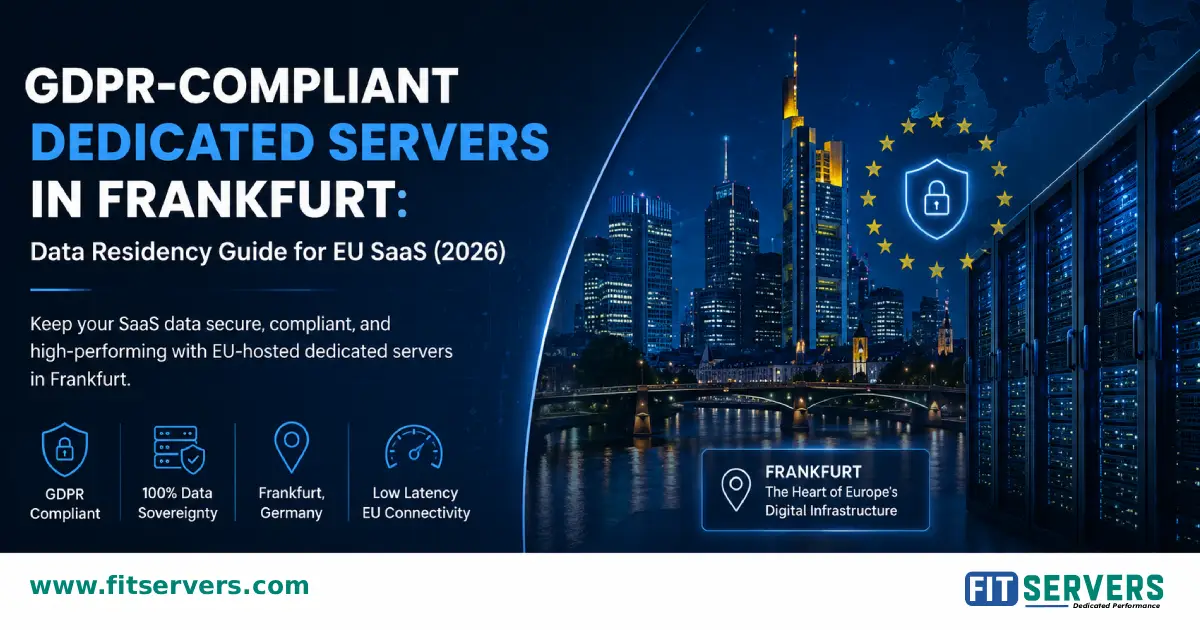
If you are operating a Software-as-a-Service (SaaS) business that handles the personal data of European Union citizens, compliance is no longer just a legal checklist—it is a core business survival metric. In 2026, as data privacy regulations continue to tighten globally, the physical location of your servers matters more than ever. Simply spinning up a cloud instance and hoping for the best is a recipe for catastrophic fines and eroded customer trust.
For SaaS platforms targeting the European market, Frankfurt, Germany, has emerged as the undisputed king of data residency and network performance. But choosing a location is only half the battle. The underlying infrastructure—specifically, utilizing bare metal dedicated servers rather than shared cloud environments—is the key to achieving true data sovereignty.
In this comprehensive guide, we will break down the complexities of GDPR data residency requirements, explore the unique infrastructure advantages of Frankfurt, and explain why EU-based dedicated servers are the safest and most performant choice for your SaaS application.
01 Demystifying GDPR Data Residency and Sovereignty in 2026
The General Data Protection Regulation (GDPR) mandates strict rules regarding how the personal data of EU residents is collected, processed, and stored. While the GDPR does not explicitly state that data must physically remain within the borders of the European Economic Area (EEA), it imposes incredibly stringent safeguards on international data transfers.
Transferring data outside the EEA requires complex legal frameworks, such as Adequacy Decisions or Standard Contractual Clauses (SCCs). For many SaaS companies, attempting to navigate these cross-border data transfer mechanisms is legally risky, financially draining, and operationally inefficient.
The simplest, most ironclad way to comply with GDPR's transfer restrictions is to practice strict data residency: keeping the data physically within the EU.
The Difference Between Residency and Sovereignty
Many founders confuse data residency with data sovereignty. This is a critical distinction:
This is a physical and geographical configuration. It simply means your data is physically stored on a hard drive located within a specific country (e.g., in a Frankfurt data center).
This refers to the legal jurisdiction that governs the data. Sovereignty determines which laws apply and, crucially, who can compel the disclosure of that data.
This distinction is precisely why hosting on a US-based hyperscale cloud provider (like AWS, Google Cloud, or Azure)—even if you select their "Frankfurt Region"—can expose your SaaS to legal jeopardy.
02 The Hyperscaler Trap: Why Jurisdiction Matters
A common misconception among SaaS developers is that deploying their application to an AWS or Azure availability zone in Frankfurt automatically guarantees GDPR compliance and data sovereignty. It does not.
While the data physically resides in Germany (achieving data residency), these cloud providers are incorporated in the United States. Therefore, they are subject to US laws, specifically the US CLOUD Act. The CLOUD Act allows US federal law enforcement to compel US-based technology companies to hand over data stored on their servers, regardless of where those servers are physically located in the world.
This creates a direct legal conflict. GDPR Article 48 explicitly prohibits transferring EU data to non-EU authorities based solely on a foreign court order. However, the US CLOUD Act demands that US companies comply with exactly those orders. As a European SaaS provider or a business dealing with EU citizens, relying on US-owned infrastructure means your data is subject to foreign surveillance laws (like FISA 702), completely undermining your data sovereignty.
The Solution: EU-Hosted Dedicated Servers
To achieve total compliance and protect your users' privacy, you need both data residency (servers physically in Europe) and data sovereignty (servers owned and operated by entities not subject to the US CLOUD Act). By leasing dedicated servers from an independent hosting provider operating out of Frankfurt, you eliminate the jurisdictional overreach of foreign entities. You retain absolute control over the physical hardware, the hypervisor, the operating system, and the data itself.
03 Why Frankfurt? The Intersection of Law and Infrastructure
When choosing a data residency location within the EU, Frankfurt am Main stands out as the premier destination for several interconnected reasons spanning legal protection, economic stability, and unparalleled networking capabilities.
Germany's Stringent Privacy Laws
Beyond the baseline requirements of the GDPR, Germany enforces its own incredibly strict national privacy legislation, known as the Bundesdatenschutzgesetz (BDSG). Germany has historically been one of the most privacy-conscious nations in the world.
The Financial Capital of the EU
Frankfurt is the financial center of the European Union and home to the European Central Bank. Because the financial sector demands the highest tiers of physical security and redundant power grids, Frankfurt's data centers are engineered to the most exacting standards on earth.
When you tell an enterprise prospect, "Our infrastructure runs on dedicated servers geographically locked to Frankfurt, shielded by both GDPR and German federal law," you instantly remove compliance objections during the sales cycle.
04 The DE-CIX Advantage: Zero-Compromise Latency
Compliance is paramount, but a SaaS application must also be fast. In the modern web, high latency leads to application abandonment, poor user experience, and increased churn. This is where Frankfurt truly outshines every other European location.
Frankfurt is home to DE-CIX (Deutscher Commercial Internet Exchange), one of the largest Internet Exchange Points (IXPs) in the world. An Internet Exchange Point is the physical infrastructure through which ISPs, Content Delivery Networks (CDNs), and enterprise networks connect to exchange internet traffic.
- Massive Throughput: DE-CIX Frankfurt routinely handles peak data throughputs exceeding 19.6 Terabits per second (Tbps).
- Direct Peering: Because thousands of networks peer directly at DE-CIX, data does not have to travel through convoluted, multi-hop transit routes. It travels almost instantly from your dedicated server to the end-user's ISP.
Hosting your dedicated servers in a Frankfurt data center connected to DE-CIX effectively places your application in the geographical and topological center of the European internet.
| Target User Location | Average Ping from Frankfurt | Performance Impact |
|---|---|---|
| Berlin, Germany | ~5ms | Instantaneous |
| Amsterdam, NL | ~8ms | Instantaneous |
| Paris, France | ~10ms | Imperceptible delay |
| London, UK | ~15ms | Imperceptible delay |
| Warsaw, Poland | ~20ms | Excellent for real-time SaaS |
Whether your SaaS involves real-time collaboration, heavy database queries, or high-frequency financial transactions, the reduced "hops" and ultra-low latency provided by Frankfurt's network ecosystem ensure your application feels incredibly responsive to users anywhere from Madrid to Stockholm.
05 Key Hardware Considerations for a Compliant SaaS
Transitioning to dedicated servers in Frankfurt gives you complete control over your hardware stack. To maximize the performance and security of your SaaS, focus on the following server specifications:
NVMe Storage Arrays
Traditional SSDs are fast, but NVMe drives communicate directly via the PCIe interface. For database-heavy SaaS applications (like CRMs or analytics dashboards), NVMe drives drastically reduce read/write bottlenecks.
High-Bandwidth Unmetered Uplinks
A fast server is useless if it is choked by a narrow network pipe. Look for dedicated servers that offer 1Gbps to 10Gbps dedicated uplinks. Unmetered bandwidth ensures you are not hit with surprise overage charges during traffic spikes.
Hardware-Level DDoS Protection
The larger your SaaS grows, the bigger a target it becomes. Ensure your Frankfurt dedicated server includes robust, inline DDoS mitigation to scrub malicious traffic before it reaches your application layer.
Isolated Private Networks (VLANs)
If your SaaS requires a multi-server architecture, you must be able to connect them via a secure backend private network. This ensures backend queries never traverse the public internet, adding a crucial layer of security required by GDPR.
06 The Business Impact: Trust as a Competitive Advantage
In a crowded SaaS marketplace, treating GDPR as an afterthought is a liability. Non-compliance can result in fines of up to €20 million or 4% of your annual global turnover, whichever is higher. But beyond the financial penalties, the reputational damage of a data breach or a compliance violation can destroy a software company overnight.
Conversely, proactively architecting your infrastructure around data privacy transforms compliance from a cost center into a powerful marketing tool. By deploying your application on independent, highly secure dedicated servers in Frankfurt, you can offer your clients airtight guarantees:
"Your data is stored exclusively on bare-metal dedicated hardware in Frankfurt, Germany. It never leaves the European Union. We retain absolute sovereignty over the physical machines, entirely isolated from the jurisdictional reach of the US CLOUD Act."
This level of assurance shortens enterprise sales cycles, easily passes vendor risk assessments, and builds unshakeable trust with your European user base.
FAQ Frequently Asked Questions
Do I need a dedicated server to be GDPR compliant?
Why is Frankfurt better than London for EU data residency?
What is DE-CIX and why does it matter?
Ready to Deploy in Europe's Network Hub?
At Fit Servers, we provide enterprise-grade bare metal infrastructure designed for the specific needs of modern software companies. Our Frankfurt-based dedicated servers offer the perfect synthesis of strict German data privacy compliance, unmetered high-bandwidth connectivity, and the raw computing power required to scale your SaaS application.