ECC memory is a standard part of modern server infrastructure because memory errors can affect system stability and data integrity. But moving from DDR4 ECC to DDR5 ECC is not simply a matter of getting a newer version of the same memory technology.
DDR5 changes the memory architecture itself.
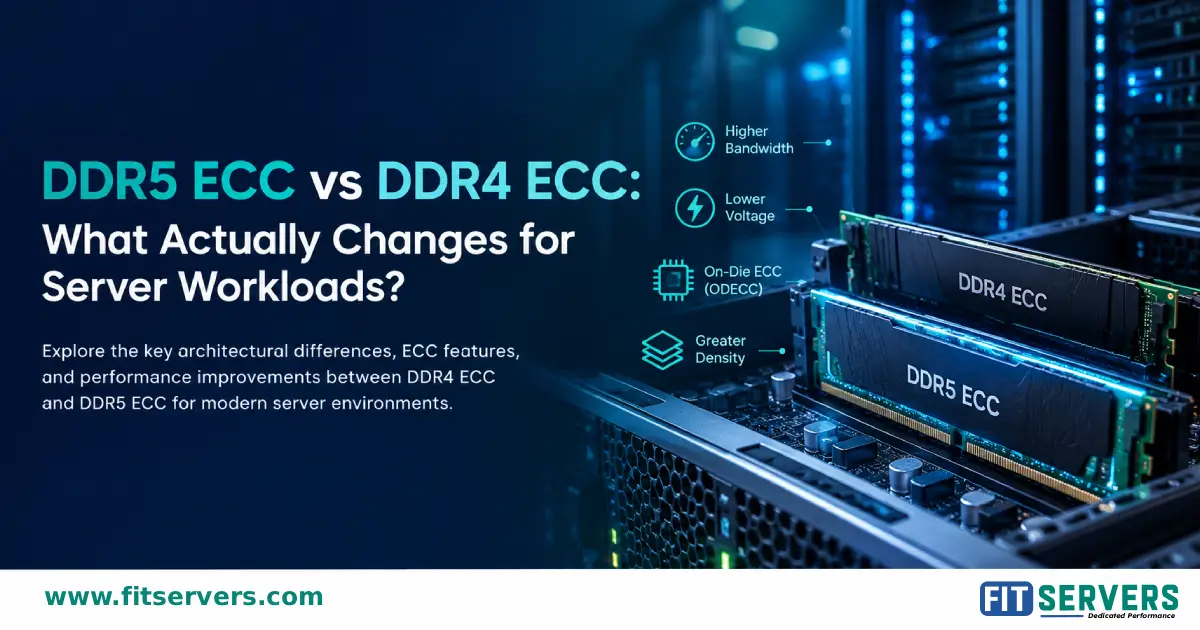
It introduces higher standard data rates, two 32-bit subchannels per module, different signaling technology, lower operating voltage, higher-density DRAM options, and On-Die ECC (ODECC) inside each DRAM chip. Server-class DDR5 modules also continue to provide the additional ECC capability used by the system's memory controller.
The result is a memory platform designed for higher bandwidth and greater density, while maintaining the error-management features expected in server environments.
DDR4 ECC vs DDR5 ECC at a Glance
| Feature | DDR4 ECC | DDR5 ECC |
|---|---|---|
| Typical server module | ECC RDIMM / LRDIMM | ECC RDIMM / newer server types |
| Standard data rates | 1600–3200 MT/s | Starts at 4800 MT/s |
| Operating voltage | Around 1.2 V | Around 1.1 V |
| On-Die ECC inside DRAM | No | Yes |
| System-level ECC | Yes, with supported platform | Yes, with supported platform |
| Memory architecture | Conventional 64-bit data path | Two independent 32-bit subchannels |
| Burst length | BL8 | BL16 |
| DRAM banks | 16 | 32 |
| Higher-density DRAM | More limited | Higher-density devices available |
| Compatibility | DDR4 platform required | DDR5 platform required |
Micron's DDR4 and DDR5 documentation identifies DDR4 data rates beginning at 1600 MT/s, while DDR5 starts at 4800 MT/s. Actual speeds depend on the processor, motherboard, and platform configuration.
First: What Does ECC Actually Do?
ECC stands for Error-Correcting Code. In server memory, ECC allows the memory subsystem to detect and correct certain memory errors rather than simply passing corrupted data to the processor.
Server-class ECC modules contain additional memory bits used by the memory controller for error detection and correction. This is particularly important in servers because they can operate continuously for long periods while handling large amounts of data. Databases, virtualization platforms, application servers, and scientific workloads can keep large amounts of memory active for extended periods. An undetected memory error can therefore have consequences beyond a single application operation.
ECC is about data integrity and reliability, not about making memory inherently faster.
The Important DDR5 Difference: On-Die ECC
This is where many comparisons become misleading. DDR5 introduced On-Die ECC, commonly abbreviated as ODECC.
On-Die ECC operates inside the individual DRAM chip. It helps detect and correct certain errors occurring within that DRAM device. However, it should not be confused with the ECC mechanism used at the system level. DDR5's on-die ECC cannot correct errors that occur outside the DRAM chip, such as certain errors occurring on the connection between the memory module and the processor's memory controller.
The most important distinction to remember is:
A DDR5 chip having ODECC does not automatically mean that the entire memory module is equivalent to a server ECC DIMM. For server applications, the CPU and platform still need to support the appropriate ECC memory technology.
How Server-Level ECC Differs
A server-class DDR5 ECC module contains additional DRAM resources that allow the platform's ECC mechanism to protect data across the memory interface. This is separate from the error correction taking place inside individual DRAM chips.
DDR5 DRAM Chip
On-Die ECC protects certain errors inside the chip before data is transmitted.
DDR5 ECC Server Module
Additional ECC bits provide system-level error protection across the module interface.
CPU Memory Controller
Performs the platform-level ECC operations supported by the server, correcting errors on the bus.
DDR5 Provides More Memory Bandwidth
One of the biggest practical changes is bandwidth. DDR4 scales through standard data rates up to 3200 MT/s, while DDR5 begins at 4800 MT/s in the standard DDR5 specification range. For example, theoretical bandwidth for a single 64-bit memory channel can be calculated as: Bandwidth = data rate × 8 bytes
- At DDR4-3200: 3200 MT/s × 8 bytes = 25.6 GB/s
- At DDR5-4800: 4800 MT/s × 8 bytes = 38.4 GB/s
These are theoretical per-channel figures, not guaranteed application performance. Actual server memory bandwidth depends on the processor's memory controllers, number of populated channels, DIMM configuration, memory speed, and workload. The important point is that DDR5 provides the platform with substantially more memory-transfer capacity.
Subchannels & Burst Length
Two 32-Bit Subchannels
DDR5 also changes how data is organized within a memory module. Instead of one 64-bit addressable channel, DDR5 divides the module into two independent 32-bit subchannels. For server RDIMMs, additional ECC bits are associated with each subchannel. This results in two 40-bit subchannels (32 bits of data + 8 ECC bits), giving an 80-bit module interface.
This architecture allows the memory controller to work with smaller independent transactions and can improve memory-access efficiency. It does not mean DDR5 has a physically smaller overall data interface.
Doubles the Burst Length
DDR5 also increases the minimum burst length from 8 to 16. The larger burst transfers more data during a memory operation and improves the efficiency of the memory data bus for suitable access patterns. This allows DDR5 to achieve higher effective data rates without simply increasing the internal DRAM core frequency.
Banks, Voltage & Density
More Banks Improve Parallelism
DDR5 increases the number of memory banks from 16 to 32. More banks give the memory system additional opportunities to keep different areas of memory active and can improve efficiency when workloads access memory in parallel—highly relevant to modern multi-core processors.
Lower Operating Voltage
DDR5 operates at a lower voltage (approx. 1.1V) compared to DDR4 (approx. 1.2V). It also moves the memory-management power architecture in a different direction, including the use of an onboard Power Management IC (PMIC) on the memory module.
Higher Memory Density
Higher-density memory devices make it possible to build larger-capacity modules. This matters for servers running workloads that require massive RAM (large databases, virtualization, in-memory analytics). However, maximum installed memory is determined by the entire server platform, including the CPU's memory controller and motherboard population rules.
What Does This Mean for Databases & Virtualization?
Databases
Database workloads can benefit from DDR5, particularly when memory bandwidth or capacity becomes a bottleneck. Consider a database server performing large scans across datasets that cannot remain entirely inside CPU cache. Higher memory bandwidth gives the CPU more potential data-transfer capacity.
But DDR5 is not automatically faster for every database. If a workload is primarily limited by storage latency, CPU execution, locking, network I/O, or inefficient queries, changing DDR4 to DDR5 may not solve the actual bottleneck.
Virtualization
A physical server running many virtual machines can have substantial memory requirements. Higher-capacity DDR5 modules can make it easier to build systems with large memory configurations. Higher bandwidth also helps when many virtual machines generate memory traffic simultaneously.
DDR4 ECC Is Still Useful (And You Cannot Mix Them)
The transition to DDR5 does not make DDR4 ECC obsolete. DDR4 ECC remains a valid choice for servers built around processors and platforms that support it. A properly configured DDR4 server can provide reliable memory operation for many workloads.
You Cannot Mix DDR4 and DDR5. They use different electrical characteristics, module designs, and physical keying. Moving from DDR4 to DDR5 normally means moving to a completely new server platform (CPU, motherboard, and DIMMs).
ECC, RDIMM, and Speed Are Different Things
A server specification might describe memory as: DDR5-5600 ECC RDIMM. Each part tells you something different:
- ECC describes error-detection and correction capability.
- RDIMM describes a registered memory-module design commonly used in servers.
- DDR5 describes the memory generation.
- 5600 MT/s describes the memory data-transfer rate (Memory is normally specified in MT/s, not MHz).
Does DDR5 Have Higher Latency?
Memory latency should not be judged from the data-rate number alone. A higher transfer rate does not necessarily mean every individual memory request has proportionally lower latency. Latency depends on factors such as CAS latency, memory clock, memory-controller behavior, and CPU architecture.
At the same time, DDR5's higher bandwidth can improve throughput for workloads that generate substantial parallel memory traffic. Bandwidth and latency are different performance characteristics. A workload can benefit from higher DDR5 bandwidth even if individual access latency does not improve proportionally.
What Should You Choose?
The correct choice depends on the server platform and workload. DDR5 should be selected because the workload and platform benefit from it, not simply because "5" is newer than "4."
Choose DDR4 ECC When:
- You already have a DDR4 server platform.
- The workload doesn't require additional bandwidth.
- Existing memory capacity is sufficient.
- The cost of a platform replacement is hard to justify.
Consider DDR5 ECC When:
- Building a new server on a DDR5-compatible CPU.
- The workload is memory-bandwidth intensive.
- Massive memory capacity is required.
- Deploying a high-core-count processor.
Frequently Asked Questions
What is On-Die ECC in DDR5 memory?
Does DDR5 On-Die ECC replace system-level ECC for servers?
Can I mix DDR4 and DDR5 memory modules in the same server?
Does DDR5 have higher latency than DDR4?
Ready to Upgrade Your Server Infrastructure?
Whether you require the proven stability of DDR4 or the immense bandwidth and density of DDR5 architecture, Fit Servers has the perfect high-performance bare metal solution.