Germany Dedicated Servers: The Location Advantage That Fuels Performance and Savings
When businesses evaluate where to host their infrastructure, location is not simply a logistical footnote it is a fundamental business decision that shapes application performance, legal compliance, and long-term cost. Among all European hosting destinations, Germany stands out as a rare convergence of low latency, competitive pricing, enterprise grade infrastructure, and unmatched regulatory clarity. At Fit Servers, our Germany based dedicated server offering is built around these very advantages.
Here is a thorough look at why Germany is the smart location choice for startups and enterprises alike.
Frankfurt: Europe's Network Nerve Center
The city of Frankfurt is not just Germany's financial capital — it is the heartbeat of European internet infrastructure. It is home to DE-CIX (Deutscher Commercial Internet Exchange), the world's most active internet exchange point. In November 2024, DE-CIX Frankfurt set a new global record, reaching 18.1 Tbps of traffic throughput at a single site. More than 1,100 networks peer at DE-CIX, which means data routes stay on-exchange rather than bouncing across continents, shaving precious milliseconds off every packet.
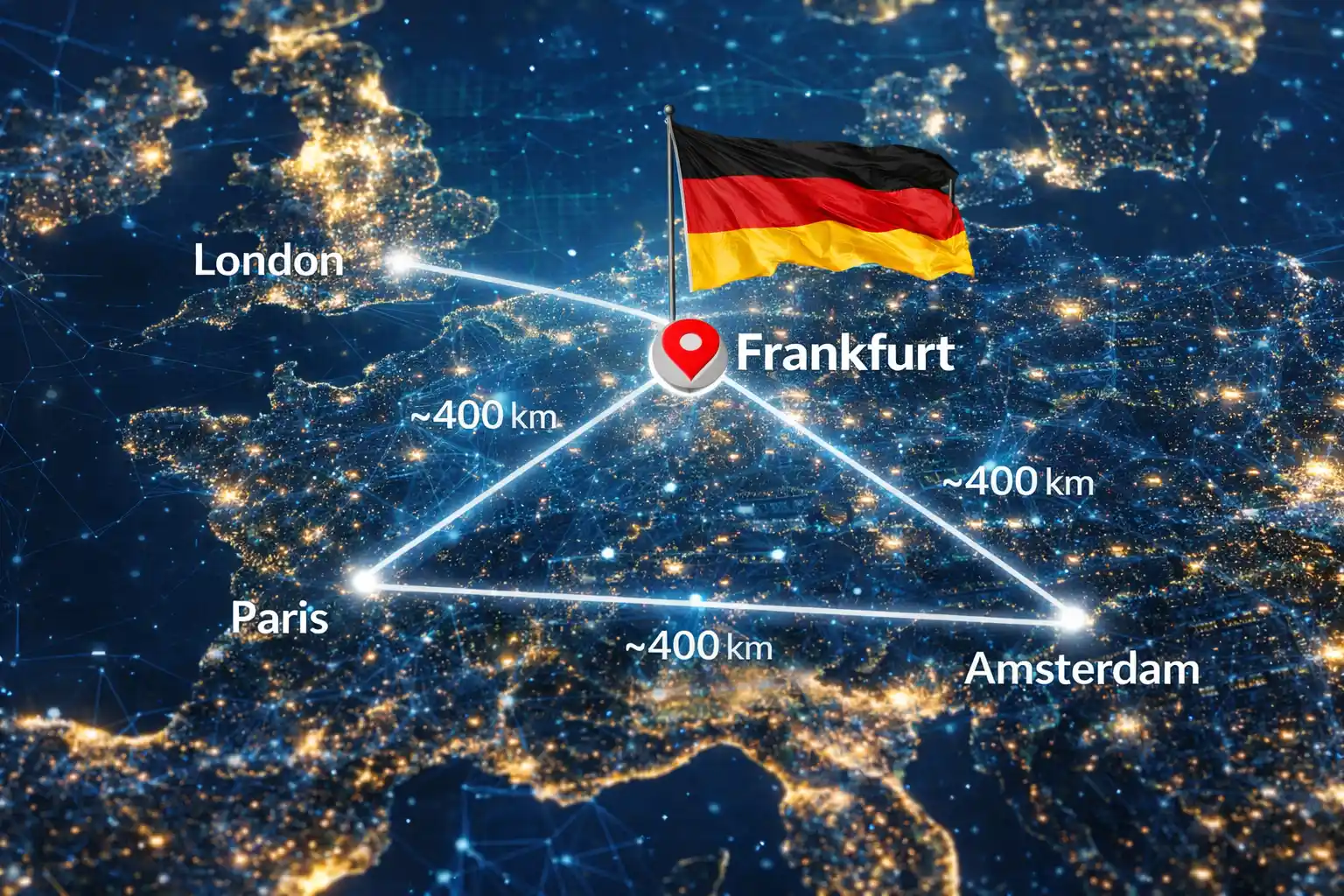
Frankfurt's geography makes it ideal for pan-European reach. It sits roughly equidistant from London, Paris, Amsterdam, and Warsaw minimizing fiber miles to every major EU population center. The result is round-trip times that simply cannot be matched from a US-based server:
Latency Snapshot (RTT from Frankfurt)
| City | RTT from Frankfurt |
|---|---|
| Paris | ~12 ms |
| London | ~16.5 ms |
| Amsterdam | ~9–11 ms |
| New York | ~85 ms |
| US West Coast | ~140 ms |
These numbers matter enormously in practice. A server anchored in Frankfurt consistently delivers sub-20 ms round-trip times to the most significant European capitals — something a US East Coast server can never achieve for EU users.
Why Latency Is a Revenue Metric
The relationship between latency and revenue is well established. Amazon famously found that every 100 ms of added latency reduced sales by 1%. More recent research from Akamai suggests cart conversion losses of up to 7% at the same threshold. For a SaaS company generating €10 million ARR, even 30 additional milliseconds across its European user base can translate into hundreds of thousands of euros in lost revenue annually.
For SaaS Platforms
Low latency directly protects Monthly Recurring Revenue. When UI round trips across Europe hover in the teens of milliseconds, the experience gap between a Paris user and a Dublin user essentially disappears.
For Fintech & HFT
Trading desks measure latency in euros per basis point. Frankfurt's colocation cages sit metres away from the Eurex and Xetra exchange engines, enabling cross-connects that deliver under 50 µs one way latency approaching the theoretical speed of light limit within the campus.
For Online Gaming
The difference between 15 ms and 130 ms is the difference between a competitive, immersive experience and visible lag. A player in Berlin pinging a Frankfurt server gets approximately 15 ms, while connecting to Dallas takes roughly 130 ms. The choice for EU gaming audiences is clear.
For APIs & Integrations
Every millisecond compounds across entire workflows. A Frankfurt-based API typically delivers faster response times for a London fintech client than a London-based API trying to reach Warsaw because DE-CIX peering eliminates the backtracking.
Competitive Pricing Without Enterprise Compromises
One of the most persistent myths about European hosting is that performance comes at a premium. Germany flips that assumption. Frankfurt alone exceeds 700 MW of installed IT capacity second in Europe only to London and its near-7% vacancy rate keeps providers competing aggressively on price. Industry observers have long noted that Germany is effectively the most cost effective place in Europe to run a dedicated server.
Typical Configurations (Fit Servers)
| Configuration | Monthly Price | Notes |
|---|---|---|
| 8-core Xeon / 32 GB RAM / 1 Gbps | 100$–200$ | Unmetered 1 Gbps port |
| 16-core EPYC / 128 GB RAM / 10 Gbps | 200$–400$ | Burstable to 20 Gbps |
| 64-core EPYC / 128 GB RAM / 100 Gbps | 900$–1000$ | HFT and AI edge workloads |
A significant cost advantage comes from 95th percentile burst billing. Most German operators and Fit Servers is no exception bill on the 95th percentile model, allowing traffic to spike to two or three times the committed rate during peak periods without penalty. You pay for your average need, not your peak moment.
Energy-Efficient Infrastructure Lowers Your TCO
Total cost of ownership is not just about the monthly server invoice. Power efficiency has become a major cost lever in the German data center ecosystem. Under updated EU energy directives, new facilities must achieve a Power Usage Effectiveness (PUE) of 1.2 or below. Existing data centers are required to reach a PUE of 1.3 or better by 2030.
This regulatory pressure is driving genuine engineering improvements in cooling and power distribution, effectively making electricity a pass-through cost rather than a margin source for data center operators. Germany also leads Europe in renewable energy adoption, with over 88% of its electricity coming from green sources making a Germany hosted server one of the most environmentally responsible infrastructure choices available.
GDPR Compliance Built Into the Location
For businesses handling European personal data, Germany is not just a performance choice it is a compliance anchor. Germany applies the EU's General Data Protection Regulation (GDPR) in conjunction with its own Federal Data Protection Act (BDSG), one of the strictest national implementations in Europe.
What this means for your business:
- Data Sovereignty: EU citizen data stays within EU jurisdiction by default.
- Clear Consent Standards: Unambiguous opt-in requirements that satisfy B2B and enterprise client audits.
- Right to Erasure: Your infrastructure is in a jurisdiction where user deletion requests are legally enforceable.
- Serious Penalties: Penalties for non-compliance can reach up to €20 million or 4% of global annual turnover, creating a safe ecosystem committed to high standards.
For SaaS companies selling to European enterprise clients, data residency in Germany is frequently a procurement requirement, not merely a preference. Hosting in Germany lets you enter those conversations with confidence.
Germany vs. USA: Choosing the Right Fit
The USA remains a strong choice for workloads where the primary audience is North American or where bandwidth cost per TB is the dominant factor (like video streaming). However, for businesses whose core users are in Europe, whose data falls under GDPR, or whose applications are latency-sensitive, Germany is the optimal starting point.
| Factor | Germany (Fit Servers) | USA |
|---|---|---|
| EU Latency | 5–30 ms | 90–150 ms |
| Privacy Law | GDPR + BDSG | HIPAA / CCPA patchwork |
| Bandwidth Cost | Slightly higher per TB to US | Lower within USA |
| Compliance Overhead | Built-in for EU data | Manual configuration required |
| DE-CIX Peering | Direct | Indirect / transatlantic |
Why Fit Servers for Germany Dedicated Hosting?
At Fit Servers, our Frankfurt facility gives you immediate access to everything covered in this article DE-CIX peering, Tier III+ infrastructure, and 95th-percentile burst billing. Whether your workload is a latency sensitive trading cache, a multi tenant SaaS platform, a gaming backend, or an AI inference edge node, we have configurations designed around your specific requirements.
You get dedicated hardware no noisy neighbors, no shared resources with full root access and the bandwidth flexibility to handle launch spikes, viral moments, and organic growth without renegotiating your contract every quarter.