USA Dedicated Servers: The Complete Guide for Businesses, Gamers, and E-Commerce
Whether you're running a growing e-commerce store, managing a high-traffic gaming community, or scaling a SaaS platform, the decision of where and how you host your infrastructure matters enormously. In 2026, USA dedicated servers have become the gold standard for businesses that refuse to compromise on performance, security, and control.
This guide covers everything you need to know — from the basics of what a dedicated server is, to where top data centers are located, to how to pick the right plan for your specific needs. Let's dive in.
What Are USA Dedicated Servers and Why Do They Matter?
A dedicated server is a physical server exclusively leased to a single client by a hosting provider. Unlike shared hosting, where hundreds of websites run on the same machine, a dedicated server means every CPU core, every gigabyte of RAM, and every bit of bandwidth belongs to you alone.
When that server is located in the United States, the benefits multiply. The USA hosts over 3,700 data centers — more than any other country in the world — and sits at the heart of some of the most advanced internet backbone infrastructure on the planet. For businesses targeting North American audiences, that geography translates directly into speed, reliability, and compliance with U.S. regulations.
Here's the simple truth: for high-traffic websites, mission-critical business applications, and competitive online gaming, a USA dedicated server isn't just an upgrade — it's a necessity.
How Does Server Location Within the USA Affect Performance?
One of the most overlooked factors in hosting is geographic proximity between the server and your users. The closer your server is to your visitors, the lower the latency (round-trip data time), and the faster your pages load.
If your target audience is:
- Primarily on the East Coast — choose a data center in Atlanta, New York, or Washington D.C.
- Primarily on the West Coast — Los Angeles, Seattle, or Hillsboro, Oregon are ideal.
- Spread across the continental USA — a central hub like Dallas, Kansas City, or Chicago minimizes average latency nationwide.
- International but USA-focused — cities like New York or Miami offer strong intercontinental cable connections.
Beyond just distance, USA data centers are directly connected to major internet exchange points (IXPs) — neutral hubs where networks interconnect. Proximity to IXPs reduces the number of network "hops" your data makes, improving speed and reducing packet loss.
Providers like Fit Servers operate across 60+ U.S. data centers, with proximity to major fiber landing points and intercontinental cable systems, ensuring low-latency delivery for users in North America, South America, Europe, Asia-Pacific, and the Caribbean.
Practical impact: A server in the same region as your audience can reduce page load times by 50–200ms compared to one on the wrong coast — a difference that directly affects bounce rates, SEO rankings, and conversion rates.
Key Benefits of USA Dedicated Servers for Businesses
1. Raw Performance Without Compromise
With a dedicated server, there's no resource competition. You get full use of the hardware — Intel Xeon or AMD EPYC processors, NVMe SSD storage, and high-speed uplinks (10G, 40G, even 100G). This means consistent, predictable performance even under peak load.
2. Full Root-Level Control
You choose the operating system (Linux or Windows), configure the software stack, install custom applications, and set your own security policies. No shared environment restrictions, no one else's configuration conflicts.
3. Enhanced Security and Isolation
Your data lives on hardware that no other customer touches. This physical isolation is irreplaceable for businesses handling sensitive customer data, payment information, or proprietary systems.
4. Compliance-Ready Infrastructure
U.S. data centers adhere to a range of compliance frameworks — HIPAA for healthcare, PCI-DSS for payment processing, SOC 2, and ISO certifications. If your business operates in a regulated industry, hosting in a compliant U.S. data center is often a legal requirement.
5. Scalable and Customizable
Unlike shared or even many cloud plans, dedicated servers can be configured with exactly the hardware your workload demands. You pay for what you need and scale when you grow.
6. SEO and Search Visibility
Search engines like Google factor page speed and server location into rankings for geo-targeted queries. A U.S.-based server helps your website rank higher for American audiences.
7. Reliability and Uptime
Enterprise-grade hardware in Tier III and Tier IV data centers, with redundant power systems, cooling infrastructure, and backup network paths, delivers the kind of uptime (99.9%+) that businesses depend on.
Top 10 Facts Everyone Should Know About USA Dedicated Servers
- The U.S. hosts more data centers than any other country — over 3,700 facilities as of 2025, with the UK in a distant second at 484.
- 86% of IT professionals still rely on dedicated servers specifically for performance predictability and compliance needs, according to research by Liquid Web.
- The dedicated server hosting market was valued at $20.15 billion in 2024 and is projected to reach $80.49 billion by 2032, growing at an 18.9% CAGR — with North America holding the largest share.
- Tier III data centers accounted for 66% of U.S. market revenue in 2024, while Tier IV (fully fault-tolerant) is the fastest-growing segment due to AI and compliance demands.
- Dedicated servers eliminate the "noisy neighbor" problem — when you share hardware in VPS or cloud environments, other tenants' workloads can slow you down without warning. Dedicated means that never happens.
- NVMe SSDs dramatically outperform traditional SATA or SAS drives, reducing I/O bottlenecks and improving database query speeds by orders of magnitude for high-traffic applications.
- Server location affects SEO — Google uses page load speed and server geography as ranking signals for local search results.
- U.S. data centers often power green energy initiatives — particularly in regions like Oregon, Washington, and California, where hydroelectric and solar sources are widely used by facilities.
- DDoS attacks are a growing threat — enterprise dedicated servers come with built-in DDoS mitigation, hardware firewalls, and network-level protection that shared environments cannot match.
- AI and compliance are driving dedicated server demand — 58% of small businesses now use generative AI (U.S. Chamber of Commerce), and running AI automation requires dedicated CPU and RAM that shared environments simply can't deliver.
Dedicated Server vs. VPS in the USA: What's the Difference?
Both a VPS (Virtual Private Server) and a dedicated server give you more control than shared hosting — but they are fundamentally different products.
| Feature | VPS | Dedicated Server |
|---|---|---|
| Physical hardware | Shared with others | Exclusively yours |
| CPU / RAM | Virtualized, shared pool | 100% allocated to you |
| Performance | Variable (subject to neighbors) | Consistent and predictable |
| Customization | Limited by hypervisor | Full root access, any OS |
| Security | Isolated via software | Physically isolated |
| Cost | Lower | Higher |
| Best for | Small/medium traffic sites | High-traffic, compliance-heavy, or resource-intensive workloads |
The key takeaway: A VPS is a virtual slice of a physical server. You're still sharing the underlying hardware with other customers. A dedicated server is the entire physical machine — no virtualization layer, no neighbors, no performance surprises.
If your application has predictable, high resource demands — a large database, heavy concurrent traffic, real-time gaming, or financial transaction processing — a VPS will always leave you wanting more. A dedicated server removes the ceiling.
USA Dedicated Server vs. Cloud Hosting: Which Is Right for You?
Cloud hosting (AWS, Azure, Google Cloud) became the default for many businesses in the past decade. But the landscape has shifted, and dedicated servers are making a strong comeback in 2026 — and for good reason.
Why Choose a USA Dedicated Server Over Cloud?
- 1. Cost Predictability: Cloud pricing is notoriously variable. Egress fees, API call charges, storage costs, and unexpected resource consumption can send monthly bills spiraling. A dedicated server has a flat, predictable monthly rate — no hidden charges.
- 2. Performance at Scale: Cloud instances are still virtualized environments sharing physical infrastructure. For workloads requiring sustained high CPU, RAM, or I/O throughput, dedicated hardware consistently outperforms equivalently-priced cloud instances.
- 3. Compliance and Data Sovereignty: Cloud providers operate globally distributed infrastructure, which can complicate data residency and compliance. A dedicated server in a specific U.S. data center gives you clear, auditable control over exactly where your data lives.
- 4. No "Wait Tax": As of 2027, cloud pricing has trended upward due to infrastructure capacity constraints, silicon supply chain pressures, and soaring power costs in major cloud regions. Dedicated server contracts lock in pricing and protect against market volatility.
- 5. Security and Isolation: Forty-two percent of banks have migrated AI workloads away from public clouds due to security concerns. Physical isolation on dedicated hardware is simply not something cloud providers can offer.
When cloud is still better: For workloads that need to burst rapidly and unpredictably (e.g., seasonal traffic spikes), or for global multi-region deployments, a hybrid approach — dedicated servers for your core workload, cloud for elastic overflow — often gives the best of both worlds.
Why Data Security Is a Major Factor When Choosing a USA Dedicated Server
The average cost of a data breach in the U.S. reached $5.56 million in 2024, according to IBM's Cost of a Data Breach report — and that's before factoring in regulatory fines, reputational damage, and customer churn.
Dedicated servers address security at multiple layers:
- Physical security: Your data sits on hardware in a locked cage inside a data center with biometric access controls, 24/7 security staff, and surveillance systems. No other customer's code runs on your server.
- Network security: Enterprise-grade dedicated hosting includes DDoS protection, hardware firewalls, private VLAN configurations, and the ability to set up your own intrusion detection and prevention systems.
- Software security: Full root access means you control every software layer — your OS, your firewall rules, your encryption standards. You're not relying on a shared environment provider's security decisions.
- Compliance frameworks: U.S. data centers operate under HIPAA, PCI-DSS, SOC 2, and ISO 27001 standards. When your hosting provider can demonstrate compliance, your audits become significantly smoother.
- Zero-trust architecture: Modern U.S. data centers increasingly support zero-trust network models, where every access request is authenticated and validated regardless of whether it originates inside or outside the network perimeter.
For any business handling customer PII, health records, payment data, or proprietary intellectual property, a dedicated server in a compliant U.S. data center isn't optional — it's the foundation of a sound security posture.
Where Are the Major Data Centers for USA Dedicated Servers Located?
The United States has data center clusters in virtually every major metro area, but certain regions are particularly prominent due to their infrastructure, connectivity, and power availability.
Top U.S. Data Center Markets
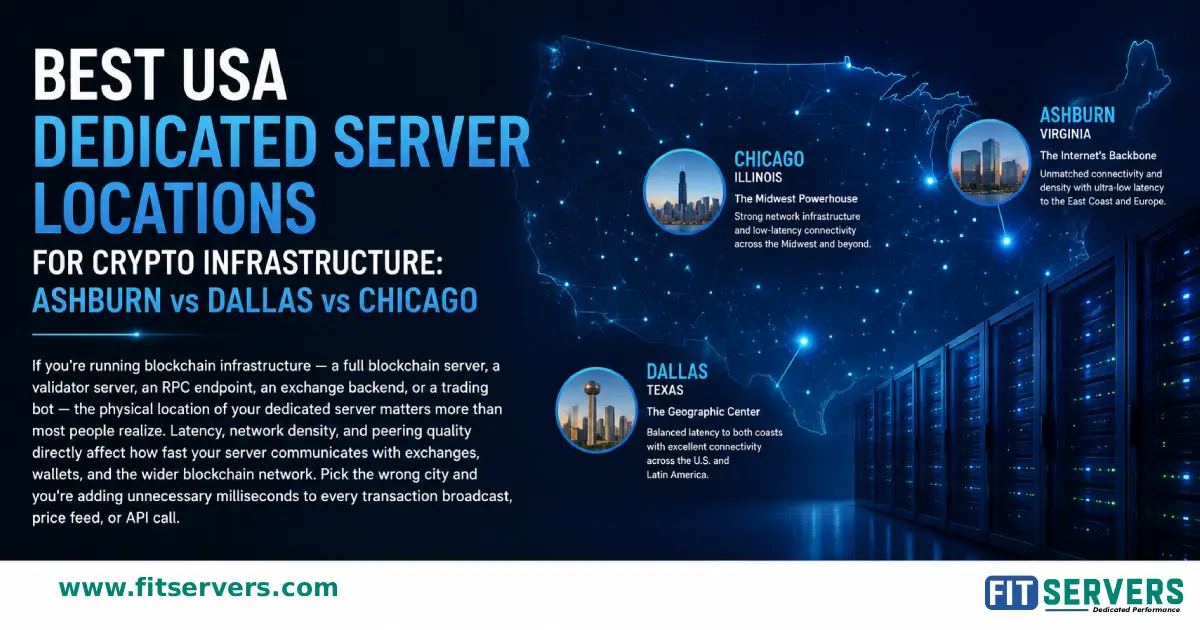
- Northern Virginia (Ashburn) — The world's largest data center market by capacity, home to AWS, Microsoft, Google, and hundreds of colo providers. Unmatched connectivity to East Coast and transatlantic cable systems.
- Dallas, Texas — Central U.S. hub with strong connectivity to both coasts and Latin America. Business-friendly climate and no state income tax make it a top choice.
- Atlanta, Georgia — The southeastern internet hub, with major fiber routes and strong latency profiles for the Southeast and Midwest.
- Seattle / Hillsboro, Oregon — Major West Coast hubs with access to transpacific cable systems. Oregon offers green energy advantages and cooler climates for efficient cooling.
- Los Angeles, California — Critical hub for transpacific connectivity and serving the dense California market.
- Chicago, Illinois — A financial data center hub (home to NYSE and CME trading infrastructure) with strong central U.S. connectivity.
- New York / New Jersey — Dense financial and media sector concentration, with direct transatlantic cable access.
- Phoenix, Arizona — Growing hub with low natural disaster risk, stable climate, and expanding renewable energy infrastructure.
- Kansas City / Denver — Central U.S. locations ideal for minimizing latency across the full continental U.S.
Fit Servers operates dedicated server facilities across many of these key markets — including Atlanta, Seattle, Hillsboro, Phoenix, Kansas City, Denver, Detroit, and Minneapolis — giving businesses the flexibility to place their infrastructure exactly where their audience needs it.
When Should You Upgrade from Shared Hosting to a USA Dedicated Server?
Shared hosting is an appropriate starting point for small websites and new projects. But there are clear signals that you've outgrown it:
- Traffic thresholds: If your site consistently receives more than 50,000–100,000 monthly visitors, shared hosting's resource limits will create slow load times and potential downtime.
- Performance complaints: If users regularly report slow page loads or your analytics show high bounce rates from slow performance, shared hosting is likely the culprit.
- Security requirements: If you handle customer payment data, health information, or any PII, shared hosting environments don't provide adequate isolation or compliance capabilities.
- Custom software needs: If you need to install specific software, custom PHP versions, Node.js environments, or configure server-level settings, shared hosting environments are too restrictive.
- E-commerce growth: Once your store is processing meaningful transaction volume, the risk of downtime or a security breach on shared hosting becomes unacceptably expensive.
- Database intensity: Applications with large, frequently queried databases — CRMs, ERPs, analytics platforms — need dedicated resources that shared environments cannot provide.
- Application hosting: Running APIs, microservices, or containerized workloads requires a level of control and resource guarantee that only a dedicated server delivers.
The short answer: upgrade when performance, security, compliance, or control limitations are directly costing you business.
Compare the Top 5 Solutions for USA Dedicated Servers
There are many providers in the market. Here's an honest comparison of what to look for and how major options stack up:
1. Fit Servers
- Best for: Businesses needing broad U.S. geographic coverage, scalable enterprise hardware, and transparent pricing.
- 60+ U.S. data centers
- Intel Xeon and AMD EPYC configurations
- 10G/40G/100G uplinks available
- NVMe SSD storage options
- Unmetered bandwidth plans available
- No hidden fees; single monthly invoice
- 25 internet exchange peering points
- Entry pricing from ~$97/month (Seattle) to $233+/month for higher-spec configs
- Green energy options in Oregon, Washington, and California
2. Liquid Web
- Best for: Managed dedicated hosting with premium support SLAs.
- Strong managed service offering (patching, monitoring, backups)
- U.S.-based 24/7 support with quick response guarantees
- Higher price tier reflects hands-on management
- Good for businesses without dedicated DevOps staff
3. Hivelocity
- Best for: Instant-deploy bare metal with hourly billing options.
- Multiple U.S. locations (Tampa, Atlanta, New York, Los Angeles)
- Rapid provisioning
- Good for short-term projects or variable workload needs
- Strong DDoS mitigation
4. IONOS (1&1)
- Best for: Budget-conscious buyers wanting no minimum-term contracts.
- Per-minute billing
- No setup fees
- AMD and Intel options
- Good entry point for businesses testing dedicated hosting
- Less geographic diversity than some competitors
5. Hostkey (New York)
- Best for: New York-based deployments with competitive pricing and GPU options.
- Tier III Opti9 data center in New York
- Free basic DDoS protection
- GPU server availability
- Up to 10 Gbps connectivity
- Solid choice for media, AI inference, or East Coast-focused workloads
Bottom line: The right choice depends on your geography, workload type, need for management, and budget. For businesses that want maximum location flexibility, modern hardware, and predictable costs, Fit Servers offers one of the broadest footprints in the U.S. market.
Guide to Choosing a Dedicated Server Plan for an E-Commerce Website
E-commerce has unique server requirements. A crashed server during a peak sales event isn't just an inconvenience — it's direct lost revenue and potential permanent customer loss.
Step 1: Estimate Your Traffic and Transaction Volume
Calculate your peak concurrent users and average page weight. A small-to-medium store with up to 10,000 daily visitors may be well served by a mid-range dedicated server (8–16 cores, 32–64GB RAM, NVMe SSD). A large store during holiday peaks may need 32+ cores, 128GB+ RAM, and 10G bandwidth.
Step 2: Choose the Right Location
Identify where your customers are. If 80% of your buyers are on the U.S. East Coast, an Atlanta or New York server will dramatically outperform one in Seattle.
Step 3: Prioritize Storage Type
E-commerce databases are read/write intensive. Choose NVMe SSD storage over HDD or even standard SATA SSD. The I/O performance difference translates directly into faster product searches, checkout processing, and inventory updates.
Step 4: Plan for PCI-DSS Compliance
If you process payments directly (even via Stripe or PayPal), your hosting environment must support PCI-DSS compliance. Ensure your provider's data centers are certified and that you have the ability to configure network segmentation and access controls.
Step 5: Select an Appropriate Bandwidth Plan
E-commerce sites with product images, video, and interactive content can consume significant bandwidth. Look for unmetered or high-cap bandwidth plans. Fit Servers offers configurations with unmetered 1Gbps bandwidth — ideal for stores with heavy media assets.
Step 6: Plan for High Availability
Consider a load-balanced setup across two servers, or a primary server with a warm standby. Database replication ensures your product catalog and order data survive any single hardware failure.
Step 7: Managed vs. Unmanaged
If your team lacks server administration expertise, choose a managed dedicated server — the hosting provider handles OS updates, security patches, and monitoring. Unmanaged is cheaper but requires in-house expertise.
Step 8: Test Before Peak Season
Always provision and load-test your dedicated server before major sales events (Black Friday, Cyber Monday, etc.). A server that handles normal load may still have bottlenecks at 10x traffic.
How to Choose a Reliable USA Dedicated Server Host for Gaming
Gaming servers have a unique set of demands: ultra-low latency, DDoS resilience, consistent uptime, and the ability to handle sudden player spikes.
Latency Is Everything
For competitive gaming, every millisecond matters. Choose a data center geographically closest to your player base. If your community is spread nationally, a central hub (Dallas, Kansas City) often gives the best average latency across all players. For East Coast-heavy communities, Atlanta or New York are optimal.
Look for DDoS Protection as Standard
Gaming servers are prime targets for DDoS attacks — rival communities or disgruntled players use them to knock servers offline. Ensure your provider includes hardware-level DDoS mitigation as a standard feature, not a paid add-on. Fit Servers includes DDoS protection across its network infrastructure.
High-Speed Uplinks Matter
Game server performance isn't just about CPU — it's also about network throughput. Look for providers offering 1Gbps minimum uplinks, with 10G options available for large player populations. Low-latency network paths to major IXPs are critical.
NVMe Storage for Game Files
Modern game servers — especially modded Minecraft, Rust, ARK: Survival Evolved, or custom game modes — read and write large amounts of data constantly. NVMe storage ensures map loads, player data saves, and plugin operations happen without lag spikes.
Full Root Access for Game Panel Installation
Gaming server management requires tools like Pterodactyl, TCAdmin, or custom game control panels. Ensure you have full root access to install your preferred management software.
Consider the Hardware Spec for Player Count
General guidance:
- Under 50 concurrent players: 4–8 cores, 16–32GB RAM, 500GB NVMe
- 50–200 concurrent players: 8–16 cores, 32–64GB RAM, 1TB NVMe
- 200+ concurrent players or multiple game instances: 16–32 cores, 64–128GB RAM, 2TB+ NVMe
Evaluate Support Response Times
Gaming servers need fast support when something breaks. Look for a provider with 24/7 live support and a track record of rapid response. Fit Servers provides round-the-clock support with a team experienced in complex hosting configurations.
Check for IPMI / KVM Access
Remote access to your server's hardware console (IPMI or KVM over IP) is essential when software crashes prevent normal SSH access. This lets you reboot, reinstall, or diagnose issues without waiting for a data center technician.
Why Fit Servers for USA Dedicated Hosting?
Fit Servers has built its reputation on a simple promise: enterprise-grade hardware, transparent pricing, and a network built for serious workloads.
With over 60 U.S. data center locations, 5.5 Tbps network capacity, 25 internet exchange peering points, and high-speed uplinks reaching 100Gbps, Fit Servers is architected for businesses that can't afford to compromise. From startups deploying their first dedicated server to multinational enterprises running complex distributed applications, the platform scales to match your ambitions.
Pricing is straightforward — one clear monthly invoice, no VAT surprises, no hidden fees. Configurations span entry-level Intel Xeon setups starting from under $100/month to high-density AMD EPYC machines with 128+ cores and multi-TB NVMe arrays. Many data centers in Oregon, Washington, and California operate on green energy, supporting both performance and sustainability goals.
Whether you're running a high-traffic e-commerce store, a competitive gaming community, a SaaS platform, or a data-intensive enterprise application — a USA dedicated server from Fit Servers puts world-class infrastructure in your hands.
Final Thoughts
The dedicated server market in the USA is growing fast — projected to reach $80+ billion globally by 2032 — and for good reason. As AI workloads, compliance requirements, and performance expectations continue to rise, the physical isolation, raw compute power, and geographic precision of a USA dedicated server offer advantages that no shared, VPS, or cloud environment can replicate.
Choose your location strategically. Match your hardware to your workload. Prioritize security and compliance from day one. And partner with a provider who treats your server's performance as seriously as you do.