With India's operational IT load capacity scaling massively to meet enterprise demands, localizing your data is no longer just a performance strategy, it is a legal necessity under the Digital Personal Data Protection (DPDP) Act.
However, selecting a hosting region requires a look beyond simple control panel dropdown menus. Because network traffic physically travels through fiber optic cables, geographical distance introduces a baseline physical delay: every 100 kilometers adds roughly 1 millisecond (ms) of one-way latency.
For businesses looking to provision dedicated servers in India, this choice directly impacts search engine visibility and user conversion rates. Minimizing the network round-trip time directly optimizes your Time to First Byte (TTFB) and First Contentful Paint (FCP), helping your digital assets clear Google’s strict Core Web Vitals thresholds for organic ranking.
Here is the technical, data-driven breakdown of India's top three data center hubs to help you achieve the lowest possible ping times for your workloads.
Understanding the Foundation: Tier III vs. Tier IV Infrastructure
Before evaluating cities, it is essential to understand the structural tier of the facility housing your bare-metal setup. In India, data centers are primarily categorized into two classifications:
Tier III Facilities 99.98% SLA
These environments guarantee a roughly 1.6 hours of maximum allowable downtime per year. They feature N+1 redundant power and cooling paths, ensuring that hardware maintenance can be performed without taking the servers offline.
Tier IV Facilities 99.99% SLA
Fully fault-tolerant infrastructures operating with a completely compartmentalized 2N or 2N+1 architecture. If a catastrophic structural failure occurs on one path, the server continues running seamlessly on the other.
Regional Deep Dive
Mumbai The International Gateway
Mumbai commands the lion's share of India's total data center market footprint. If your application serves a broad, distributed user base across the entire Indian subcontinent, Mumbai represents the most logically sound default deployment zone.
ISP Peering & Interconnectivity: As a coastal metropolis, Mumbai acts as the landing point for major international submarine fiber-optic cables (including AAE-1, SEA-ME-WE 5, and BBG). It features direct access to India’s busiest National Internet Exchange of India (NIXI) hub and premium carrier-neutral peering fabrics like DE-CIX Mumbai.
World-Class Data Centers: Bare-metal environments in this region are backed by hyper-scale campuses like the Yotta NM1 along with enterprise clusters from NTT/Netmagic, CtrlS, and STT GDC.
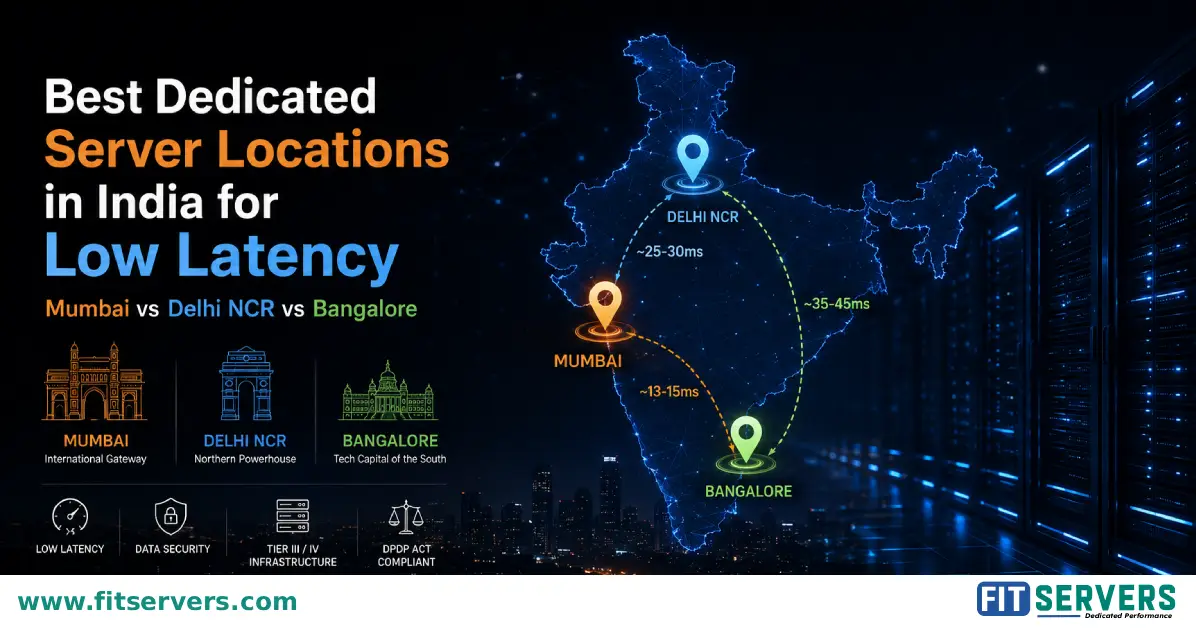
- Local (Mumbai/Pune Metro) < 5ms
- To Bangalore ~14ms
- To Delhi NCR ~28ms
- To Singapore ~60ms
Best For
High-volume e-commerce platforms, payment gateways, and gaming clusters serving domestic and international markets.
Delhi NCR The Northern Powerhouse
The National Capital Region — spanning Delhi, Noida, and Gurugram — forms the dominant digital routing nexus for the entire northern half of the country.
ISP Peering & Interconnectivity: Traffic in this cluster routes through the regional NIXI Delhi node and the localized Delhi Internet Exchange (Delhi IX). Because Delhi is landlocked, traffic intended for international destinations must first travel down long-haul domestic fiber backbones to the coastal landing stations in Mumbai or Chennai, adding roughly 15ms of unavoidable baseline latency to global requests.
- Local (Delhi/Noida/UP) < 8ms
- To Mumbai ~28ms
- To Bangalore ~40ms
Best For
Media streaming setups, logistics platforms, and B2C services targeting North Indian demographics (saves up to 20ms).
Bangalore The Tech Capital of the South
Bangalore (Bengaluru) serves as the primary epicenter for India’s software-as-a-service (SaaS), deep-tech startups, and cloud-native application deployments.
ISP Peering & Interconnectivity: The region is anchored by Bangalore IX and local NIXI routing architecture. It offers highly optimized, direct fiber cross-connects to the massive southern telecom loops connecting Karnataka, Tamil Nadu, Telangana, and Kerala.
- Local (BLR/Chennai/HYD) < 10ms
- To Mumbai ~14ms
- To Delhi NCR ~40ms
Best For
B2B enterprise SaaS architectures, automated testing pipelines, and integration with southern enterprise private clouds.
Making Your Final Deployment Decision
If your architecture relies on a single, centralized bare-metal environment to serve both the entire country and global markets, Mumbai is the undisputed choice due to its direct international cable landings.
However, if your budget supports a multi-node, distributed architecture, anchoring your primary database in Mumbai while deploying edge-compute nodes in Delhi NCR and Bangalore will ensure blazing-fast, sub-15ms latency across the entire subcontinent.
| Factor | Mumbai Hub | Delhi NCR Hub | Bangalore Hub |
|---|---|---|---|
| Primary Audience Focus | Pan-India & Global | North India Core | South India & SaaS Tech |
| International Access | Direct Cable Landing | Requires Domestic Hop | Requires Coastal Hop |
| Avg. Ping to North India | 25ms – 30ms | < 8ms | 35ms – 45ms |
| Avg. Ping to South India | 13ms – 20ms | 35ms – 45ms | < 10ms |
| Dominant Facilities | Yotta NM1, NTT, STT | AdaniConnex, CtrlS, NTT | STT GDC, Netmagic |
Frequently Asked Questions
Ready to Scale Your Indian Infrastructure?
At Fit Servers, we provide enterprise-grade, bare-metal infrastructure strategically deployed across India's premier Tier III and Tier IV data center hubs giving you the freedom to spin up environments exactly where your users are.