The Enterprise Guide to DDR5 Memory Architecture
01 What Actually Changed with DDR5
DDR5 is not just faster DDR4. The architecture is fundamentally different in ways that matter specifically for enterprise environments. Understanding the changes explains why the gains vary so dramatically between workloads.
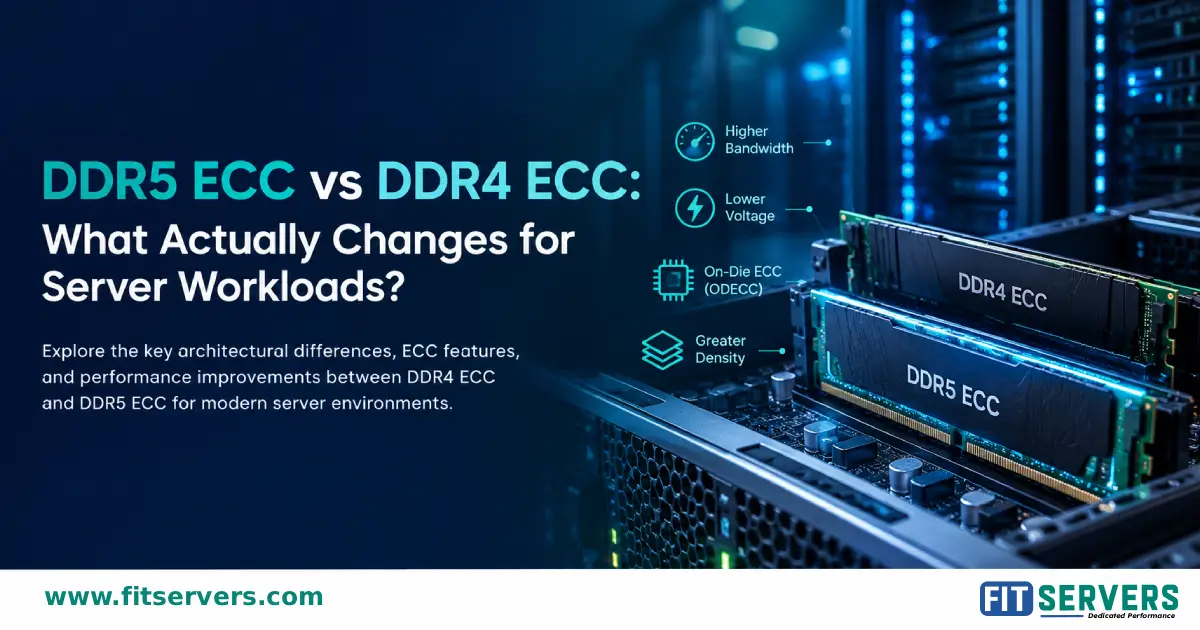
The headline number is data rate. DDR5 starts at 4,800 MT/s where DDR4 peaked at 3,200 MT/s, with enterprise DDR5 5600 now standard on platforms like AMD EPYC 9005 series and Intel Xeon 6. But the bandwidth story runs deeper than clock speed.
Each DDR5 module contains two independent 40 bit sub channels, breaking down as 32 data bits plus 8 ECC bits per sub channel. DDR4 used a single 72 bit wide channel per DIMM. This sub channel architecture improves parallelism on small random access patterns, which is exactly the kind of traffic that dominates database and virtualization workloads. It also means DDR5 can serve two independent memory requests simultaneously per module, which directly reduces queue depth under heavy concurrent load.
Power management also moved on module. DDR5 incorporates a dedicated Power Management IC on each DIMM, moving voltage regulation physically closer to the memory cells. The result is a drop from 1.2V to 1.1V operating voltage, reducing heat output per DIMM and improving signal integrity at high speeds. This is highly relevant when you populate 24 or more DIMM slots in a dual socket server.
| Specification | DDR4 (Server) | DDR5 (Server) |
|---|---|---|
| Base Data Rate | 2,133 to 3,200 MT/s | 4,800 to 5,600 MT/s |
| Max Data Rate | 3,200 MT/s | 7,200 and higher MT/s |
| Channel Architecture | Single 72 bit channel per DIMM | Two independent 40 bit sub channels per DIMM |
| Operating Voltage | 1.2V | 1.1V |
| Max Module Capacity | 64GB RDIMM | 128GB and higher RDIMM |
| CAS Latency | CL22 to CL24 | CL40 to CL52 |
| ECC | Supported on controller | On module ECC plus controller ECC |
| Power Management | Motherboard based voltage regulation | On module PMIC per DIMM |
02 The Latency Trade off You Need to Know
DDR5's higher CAS latency numbers look alarming at first. DDR4 runs at CL22 to CL24 while DDR5 starts at CL40. But raw CAS latency numbers are measured in clock cycles, not time. Because DDR5 operates at a significantly higher clock frequency, the actual nanosecond latency is comparable or even slightly better than DDR4 in many scenarios.
Example: DDR4 3200 at CL22 delivers approximately 13.75 nanoseconds of absolute latency. DDR5 4800 at CL40 delivers approximately 16.67 nanoseconds. DDR5 5600 at CL40 brings that to approximately 14.3 nanoseconds, nearly identical to DDR4 in real terms, with dramatically more bandwidth available.
For latency critical applications like high frequency trading or In Memory caching environments, this trade off requires careful evaluation. For bandwidth bound workloads like AI training, large database queries, scientific simulation, and video transcoding, the latency difference is irrelevant and the bandwidth advantage is decisive.
03 Real World Gains by Workload
The difference between DDR5's theoretical 50 percent bandwidth advantage and its real world impact comes down to one question: is your workload memory bandwidth bound? Here is how it breaks down across production enterprise scenarios.
04 Platform Matters: AMD EPYC vs Intel Xeon
Not all DDR5 deployments deliver the same bandwidth. The CPU's memory controller and channel count determine how much of DDR5's potential you actually realize.
AMD EPYC Platform
- 12 DDR5 channels per socket
- Up to 460.8 GB/s theoretical bandwidth at DDR5 4800
- DDR5 5600 support on EPYC Turin architecture
- Maximum memory bandwidth advantage in the market
- Ideal for analytics, AI, and memory intensive HPC
Intel Xeon 6 Platform
- 8 DDR5 channels per socket
- DDR5 7200 support on select server processors
- Higher per channel speed compensates for fewer channels
- Up to 210 GB/s in tested memory read benchmarks
- Stronger for latency sensitive and single threaded workloads
AMD's 12 channel memory architecture delivers approximately 50 percent more theoretical peak bandwidth than Intel's 8 channel design at equivalent DDR5 speeds. In production, this gap narrows to 20 to 35 percent on memory bound workloads, but that remains a decisive difference for AI training, big data, and analytics.
Practical Note on DIMMs per channel: DDR5 platforms typically run at rated speed with 1 DIMM per channel. Populating 2 DIMMs per channel can drop speeds by one tier, for example, from DDR5 5600 to DDR5 4800. Always confirm your memory population plan against the CPU's official memory support document before ordering.
05 When Does Upgrading Make Financial Sense?
DDR5 server RDIMMs now carry only a modest price premium over DDR4 in most configurations, roughly 15 to 20 percent more per GB as of early 2026. But the financial decision goes beyond the DIMM cost.
Upgrade makes clear sense if: you are provisioning a new server on a DDR5 platform, your primary workloads sit in the high gain tier above, or you need to maximize RAM density per slot to reach a high memory target with fewer DIMMs.
The upgrade may not justify itself if: you are running a well performing DDR4 server for web hosting, transactional databases, or caching. Pulling working DDR4 infrastructure to move to DDR5 will not recover the cost through performance gains on bandwidth insensitive workloads. The better investment in that scenario is adding RAM capacity, not generation.
Rule of Thumb: DDR5 pays for itself on new deployments and bandwidth heavy workloads. For existing stable DDR4 infrastructure running latency sensitive or I/O bound applications, stay the course and upgrade at natural hardware refresh time.
Ready for DDR5 Powered Infrastructure?
Browse our dedicated server fleet featuring AMD EPYC and Intel Xeon configurations with DDR5, available across our global data centers.