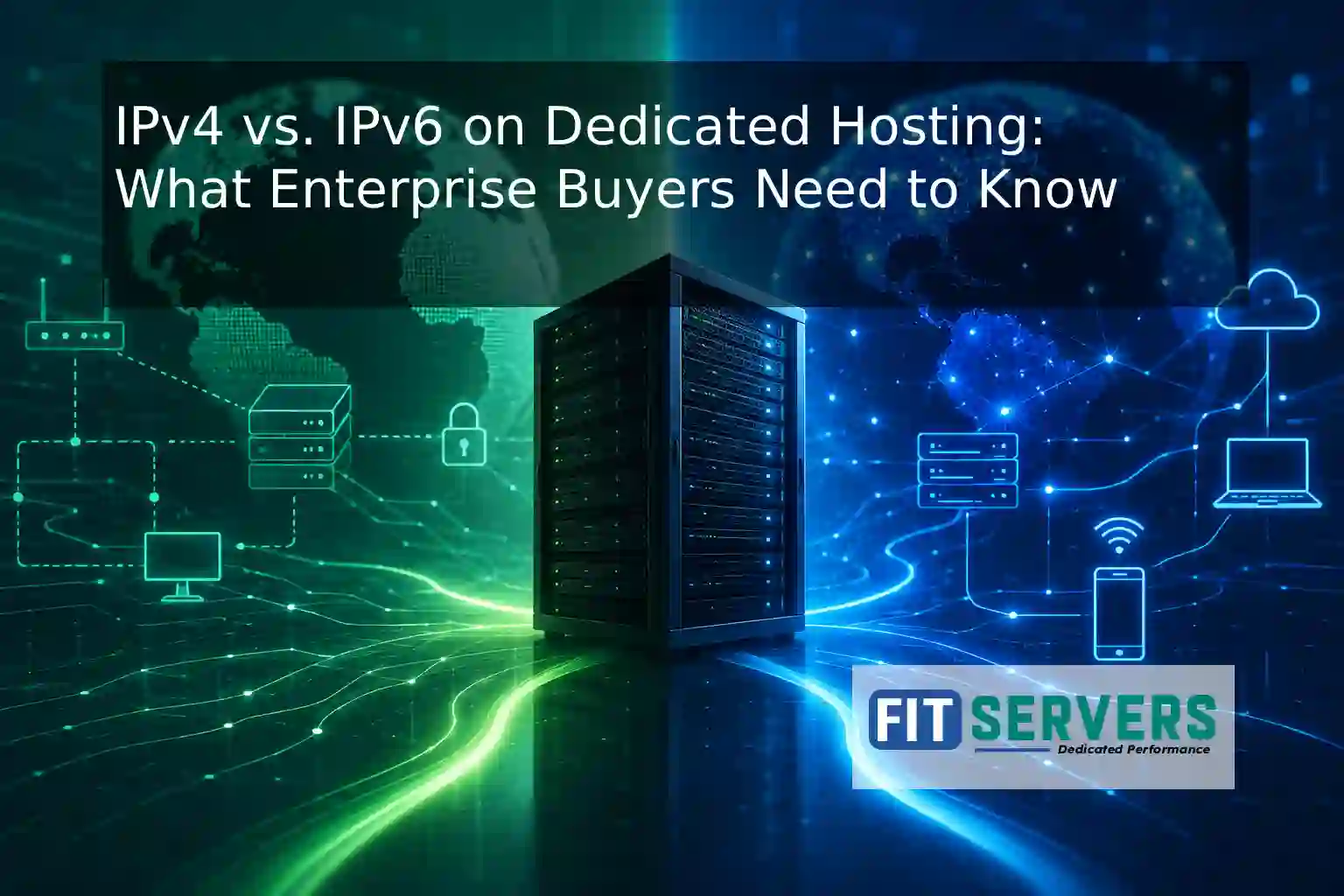
The Enterprise Guide to IPv4 vs. IPv6 on Bare Metal
In the high-stakes world of enterprise IT infrastructure, every architectural decision impacts scalability, security, and the bottom line. When deploying bare-metal dedicated servers, hardware specifications like CPU cores, NVMe storage, and RAM often dominate the conversation. However, a less glamorous but equally critical component dictates how your infrastructure interacts with the global internet: the Internet Protocol (IP) version.
For over four decades, Internet Protocol version 4 (IPv4) has been the undisputed backbone of the web. But as the internet has exploded with mobile devices, IoT sensors, and massive cloud deployments, the pool of available IPv4 addresses has run dry. Enter Internet Protocol version 6 (IPv6)—the necessary evolution of digital networking.
For enterprise buyers, CTOs, and network architects leasing dedicated hosting, the choice between IPv4 and IPv6—or the strategic implementation of both—is no longer a theoretical exercise. It is an immediate operational requirement. This comprehensive guide explores the deep technical, financial, and strategic differences between IPv4 and IPv6, and how they directly impact your dedicated server deployments.
The Fundamentals of IP Addressing
Before diving into how these protocols affect enterprise hosting, it is essential to understand the structural differences between them. An IP address is the fundamental numerical label assigned to every device connected to a computer network. It serves two principal functions: host or network interface identification, and location addressing.
What is IPv4?
Deployed in 1983 via ARPANET, IPv4 uses a 32-bit address space. This structure allows for mathematically 232 addresses, which equates to approximately 4.3 billion unique IPs. An IPv4 address is typically written in dotted-decimal format, consisting of four numbers ranging from 0 to 255 separated by periods (e.g., 192.168.1.1). When IPv4 was created, 4.3 billion addresses seemed virtually inexhaustible. However, the architects of the early internet could not have predicted the advent of smartphones, smart appliances, and massive server virtualization.
What is IPv6?
Drafted by the Internet Engineering Task Force (IETF) in 1998, IPv6 was designed explicitly to solve the exhaustion problem of its predecessor. It utilizes a 128-bit address space, allowing for 2128 addresses. To put this into perspective, IPv6 provides approximately 340 undecillion (3.4 × 1038) unique addresses. That is enough IP addresses to assign one to every atom on the surface of the Earth. IPv6 addresses are written in hexadecimal format and separated by colons (e.g., 2001:0db8:85a3:0000:0000:8a2e:0370:7334).
The IPv4 Exhaustion Crisis and Hosting Costs
For enterprise buyers looking at dedicated hosting, the most immediate pain point of IPv4 is financial. Because the Regional Internet Registries (RIRs) like ARIN, RIPE, and APNIC have officially exhausted their pools of free IPv4 addresses, the internet has shifted to an open-market model.
The IPv4 Gray Market: Today, if a hosting provider needs more IPv4 addresses, they must buy them from other organizations at auction. This secondary "gray market" has driven the price of a single IPv4 address up significantly. When you lease a dedicated server, you are not just paying for the hardware; you are paying premium monthly leasing fees for every additional IPv4 address required.
Technical Advantages of IPv6 for Bare Metal
Beyond massive cost savings, IPv6 introduces several deep technical improvements that optimize how servers route data, handle encryption, and manage network loads.
- The Eradication of NAT (Network Address Translation): Because of IPv4 scarcity, networks rely heavily on NAT, which allows a single public IP to represent an entire private network. This breaks the internet's "end-to-end" design, adds routing overhead, and complicates port-forwarding. IPv6 has so many addresses that NAT is completely unnecessary. Every VM and Docker container on your server can have its own globally routable public IP.
- Streamlined Header Format and Faster Routing: IPv4 headers are variable in length and contain 14 fields, including a checksum that must be recalculated by every router. IPv6 introduces a fixed 40-byte header with only 8 fields and removes the IP-level checksum entirely, allowing for faster processing by core internet routers and reduced latency.
- Native Security (IPsec): When IPv6 was engineered, IPsec (Internet Protocol Security)—a suite of protocols that authenticate and encrypt data packets—was mandated as a core component of the protocol suite, making network-layer security inherently more standardized.
- Stateless Address Autoconfiguration (SLAAC): Configuring network interfaces manually is prone to human error. SLAAC allows an IPv6 host to automatically configure its own IP address when connected to an IPv6 network, massively speeding up the deployment of large server clusters.
Head-to-Head Comparison Table
To summarize the technical distinctions, here is a definitive comparison for network architects:
| Feature | IPv4 | IPv6 |
|---|---|---|
| Deployment Year | 1983 | 1998 (Standardized later) |
| Address Length | 32-bit | 128-bit |
| Address Format | Dotted Decimal (e.g., 192.168.1.1) | Hexadecimal (e.g., 2001:db8::ff00:42:8329) |
| Total Address Space | ~4.3 Billion | ~340 Undecillion |
| Header Complexity | Variable length, 14 fields, includes checksum | Fixed 40-byte length, 8 fields, no checksum |
| NAT Dependency | Heavily reliant on NAT to preserve IPs | NAT is obsolete; true end-to-end connectivity |
| Security (IPsec) | Optional / Backported | Native / Built-in to protocol design |
| Auto-configuration | Requires DHCP stateful configuration | Supports SLAAC and DHCPv6 |
Virtualization, Cloud Native, and Kubernetes
For the enterprise buyer, a bare-metal dedicated server is rarely used to host a single application. It is almost always utilized as a hypervisor (using VMware ESXi, Proxmox, or Microsoft Hyper-V) or as a node in a containerized environment (Docker, Kubernetes).
The IPv4 Virtualization Headache
If you rent a dedicated server with a primary /29 IPv4 block (5 usable IPs) but want to spin up 30 virtual machines, you are forced to set up a virtual router within your host. You must put all 30 VMs on a private local network and meticulously configure NAT port forwarding to map external traffic. It is tedious, prone to security misconfigurations, and difficult to scale.
The IPv6 Cloud-Native Dream
When your provider routes a /64 IPv6 subnet to your dedicated server, you have 18 quintillion IPs at your disposal. Every single Proxmox container can be assigned a dedicated public IP. Kubernetes pods can be directly addressed from the internet without complex ingress controllers bottlenecking NAT traffic. Network monitoring becomes completely transparent, as you can see exactly which VM is generating traffic without untangling NAT translation logs.
The Reality of "Dual-Stack" Hosting
Despite the overwhelming superiority of IPv6, enterprise buyers cannot simply abandon IPv4. Because the internet is fundamentally decentralized, IPv4 and IPv6 are not naturally interoperable. A user on an IPv4-only home connection cannot access an IPv6-only server without complex carrier-grade translation mechanisms.
The Solution: Dual-Stack Architecture. The industry standard for dedicated servers is Dual-Stack deployment. The server's network interface card is configured with both an IPv4 and IPv6 address. If a modern client with IPv6 connects, the server responds via IPv6 taking advantage of the speed. If a legacy client connects, it seamlessly responds via IPv4.
Strategic Recommendations for Enterprise IT Buyers
As you draft your Request for Proposal (RFP) for your next dedicated server deployment, follow these strategic guidelines regarding IP protocols:
- Demand Native IPv6: Do not settle for 6to4 tunneling protocols. Ensure the data center has native IPv6 transit from major Tier-1 carriers.
- Request a /64 Subnet Minimum: Any reputable enterprise host will route a /64 subnet to your bare metal server automatically for free.
- Audit Internal Software: Before migrating, ensure all proprietary enterprise software, databases, and backup solutions are capable of binding to IPv6 sockets.
- Optimize Firewall Rulesets: A dual-stack server requires dual firewall rules. Do not lock down the IPv4 firewall (iptables) while leaving the IPv6 firewall (ip6tables) completely open.
- Plan for IPv4 Phase-Out: Utilize IPv6 for all internal server-to-server communication, reserving expensive leased IPv4 addresses exclusively for customer-facing load balancers.
Frequently Asked Questions (FAQ)
Q: If I use IPv6, do I still need an IPv4 address on my dedicated server?
A: Yes. For a public-facing web server, you absolutely still need at least one IPv4 address. If you run an IPv6-only server, approximately half of the internet (users on legacy IPv4 networks) will be completely unable to reach your website or application.
Q: Are IPv4 addresses going to become cheaper?
A: It is highly unlikely. As cloud computing grows and remaining IPv4 blocks are hoarded by hyperscalers, the artificial scarcity will keep prices high until global IPv6 adoption crosses the ~80-90% threshold, which is still years away.
Q: How does IPv6 affect DDoS protection?
A: Volumetric DDoS attacks happen on both protocols. However, mitigating IPv6 attacks requires scrubbing hardware capable of parsing the massive IPv6 address space. When purchasing dedicated hosting, verify that your provider's inline DDoS protection explicitly covers IPv6 traffic.
Q: Can I keep my IPv6 addresses if I change hosting providers?
A: Unless you have your own Autonomous System Number (ASN) and Provider Independent (PI) address space that you announce via BGP, no. The IPv6 addresses belong to the hosting provider and will change if you migrate to a new data center.
Conclusion
The transition from IPv4 to IPv6 is the most significant infrastructural shift in the history of the internet. For enterprise buyers, understanding this protocol is no longer optional. While IPv4 remains a costly but necessary legacy requirement, IPv6 is the engine of modern scalability.
By demanding native dual-stack deployments on your dedicated servers, you avoid the heavy financial burden of IPv4 leasing, eradicate the performance bottlenecks of NAT, and future-proof your virtualized environments. The infrastructure of tomorrow is heavily interconnected, highly secure, and fundamentally relies on the endless capacity of IPv6. Ensure your data center partner is ready to provide it.