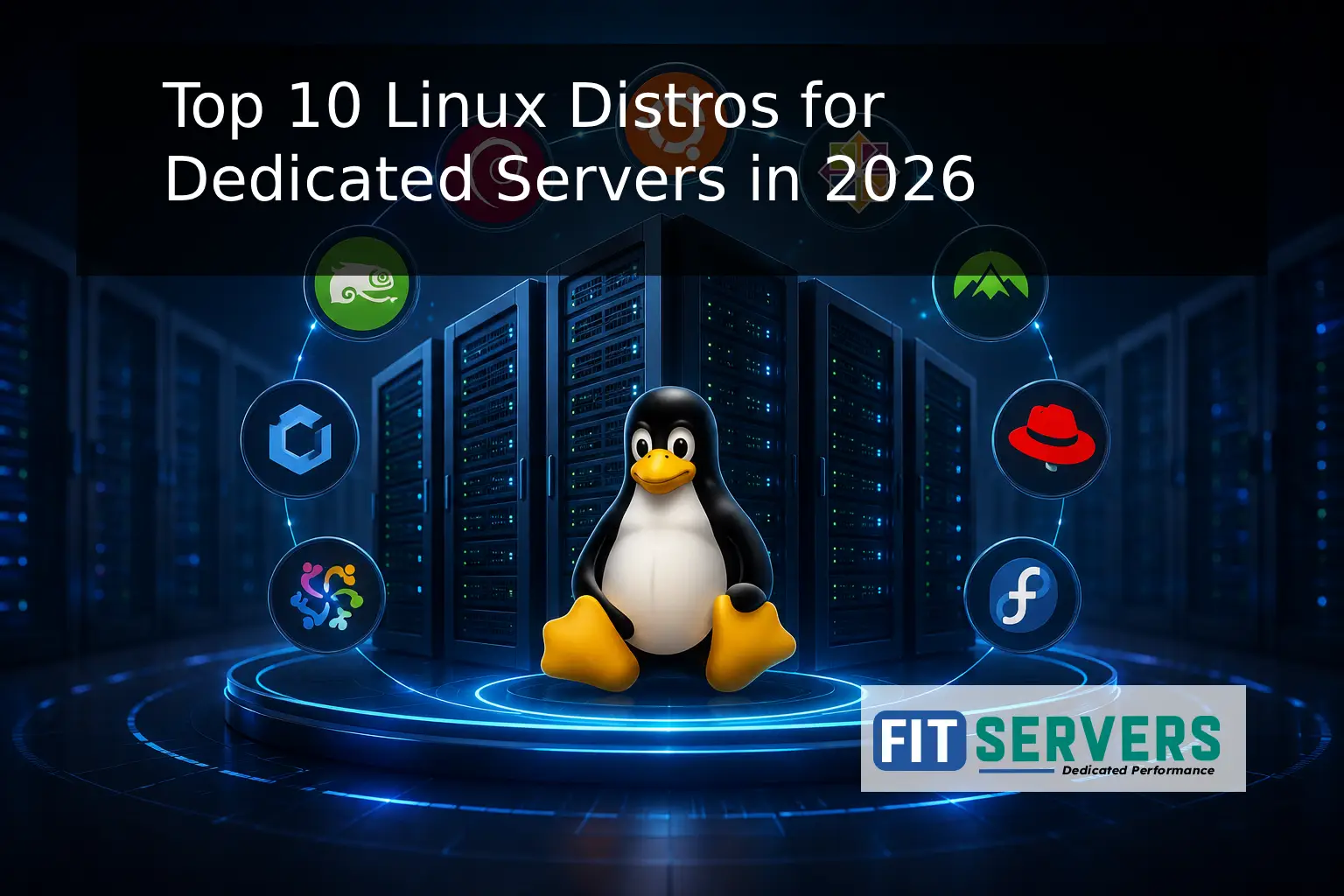
When you rent a dedicated server, the hardware is only half the equation. The Linux distribution you put on it determines your security patch cadence, your available software ecosystem, how long you can run the OS before a forced migration, and whether your preferred control panel will even work. A wrong choice creates real operational problems eighteen months in.
This guide covers ten distributions that genuinely earn their place on a dedicated server in 2026 with honest notes on where each one excels and where it falls short.
Ubuntu Server 24.04 LTS
Ubuntu Server's Long Term Support releases have become the default choice for many sysadmins, and the reasons are practical rather than hype. Ubuntu 24.04 LTS (Noble Numbat) ships with five years of standard security maintenance from Canonical through mid 2029, extendable to ten years via an Ubuntu Pro subscription. The apt package manager, comprehensive official documentation, and sheer volume of community tutorials mean most server problems have well documented solutions.
Docker, Kubernetes, Nginx, Apache, and virtually every modern web stack ship first class Ubuntu support. If you are building a DevOps environment or deploying containerised workloads, Ubuntu Server is a low friction starting point.
One honest caveat: Canonical increasingly ships some packages as Snap by default, which introduces a layer of complexity that experienced sysadmins often prefer to avoid. Most are configurable, but it is worth knowing upfront.
Debian 12 "Bookworm"
Debian is the upstream parent of Ubuntu and represents a different operating philosophy: conservative, deliberate, and deeply stable. Packages only enter the stable branch after extensive testing, which means you rarely run the newest software but you also rarely encounter unexpected breakage in production.
A minimal Debian installation is genuinely lean. It runs well on lower spec hardware and is an excellent choice for high density environments where you want the OS to stay out of the way. If your server's job is to run without demanding attention for years at a time, Debian is the strongest option on this list.
AlmaLinux 9
When Red Hat ended the CentOS Linux stable release model, AlmaLinux emerged as one of the most trusted replacements. Governed by the non profit AlmaLinux OS Foundation (initially seeded by CloudLinux Inc.), it offers Application Binary Interface (ABI) compatibility with RHEL 9, meaning software built for Red Hat's enterprise release behaves identically on AlmaLinux.
Version 9 carries a 10 year support lifecycle with security updates running through 2032. CERN and Fermilab selected AlmaLinux as their standard distribution for scientific computing environments a meaningful endorsement for stability and long term viability. For teams migrating off CentOS 7, AlmaLinux is the most frequently recommended destination.
Rocky Linux 9
Rocky Linux was created by Greg Kurtzer, one of CentOS's original founders, specifically to provide a stable, free RHEL rebuild after CentOS's direction changed. It maintains bug for bug binary compatibility with RHEL, which matters when you are running enterprise software that vendors have certified against Red Hat's release.
Like AlmaLinux, Rocky Linux 9 is supported through 2032. The Rocky Enterprise Software Foundation governs the project independently with community oversight. Both Rocky and AlmaLinux occupy similar technical ground the practical difference is often which one your team's automation scripts were already written for.
Red Hat Enterprise Linux 9
RHEL is the commercial benchmark from which AlmaLinux and Rocky Linux both derive. It is the distribution that enterprise software vendors certify against, that financial institutions require for compliance, and that comes with a formal support contract from Red Hat (now part of IBM).
RHEL requires a subscription for production use, but Red Hat offers a no cost individual developer subscription that covers a meaningful number of systems useful for testing and qualifying configurations before deploying at scale. For environments where the phrase "official vendor support" is a hard requirement, RHEL is frequently the only option on the table.
Oracle Linux 9
Oracle Linux is a free RHEL compatible distribution that includes a capability no other free distribution on this list offers: live kernel patching via Ksplice. This allows critical security patches to be applied to the running kernel without a reboot which matters significantly for servers with strict uptime requirements.
Oracle Linux also ships the Unbreakable Enterprise Kernel (UEK), an alternative kernel that adds improved hardware support and performance characteristics beyond the standard upstream kernel. The base OS is free to download and deploy; paid support is available from Oracle. If your environment runs Oracle Database, Oracle Middleware, or other Oracle products, this is the natural OS choice.
openSUSE Leap 15
openSUSE Leap shares its source code with SUSE Linux Enterprise (SLE), meaning it closely tracks an enterprise grade distribution without the licensing cost. Its standout feature is YaST a unified configuration tool available in both graphical and text based forms that simplifies network configuration, storage management, and package handling in a way most other distros do not replicate.
For teams already operating within the SUSE ecosystem or migrating from SUSE Linux Enterprise, Leap is the obvious community tier choice. It is also a solid, well maintained option for anyone willing to invest a modest amount of time learning its tooling.
Fedora Server
Fedora is the upstream testing ground for RHEL. Features and packages appear in Fedora before they graduate into Red Hat's enterprise releases which makes Fedora Server genuinely useful as a staging environment or for teams that want early access to technology before it lands in AlmaLinux, Rocky, or RHEL proper.
The critical limitation: each Fedora release carries approximately a 13 month support lifecycle. This makes it unsuitable for production servers where long term patch coverage is a requirement. Use it for development, experimentation, and qualified staging not for the server that your business depends on running at 3 a.m.
CloudLinux OS
CloudLinux OS is purpose built for hosting providers and belongs on this list for anyone running a server with multiple accounts or tenants. Its core feature Lightweight Virtual Environments (LVE) isolates each tenant's CPU, memory, and I/O usage, preventing a single resource heavy account from degrading performance across the server.
CageFS adds a further security layer by giving each user a virtualised filesystem view, preventing them from accessing other accounts data or sensitive system files. CloudLinux integrates directly with cPanel and Plesk. For managed hosting environments serving dozens of customers on a single machine, this level of isolation is not a luxury it is an operational necessity.
CentOS Stream 9
It is important to clarify what CentOS Stream actually is: it is not the stable CentOS Linux that many admins relied on for years. That project reached end of life. CentOS Stream is a continuously delivered rolling distribution that sits just upstream of RHEL packages appear here before they are included in a formal RHEL release.
This makes CentOS Stream a useful tool for developers tracking what is coming in RHEL and testing compatibility ahead of time. It is not a production grade replacement for CentOS Linux. For teams that previously relied on CentOS for stable, long running server deployments, AlmaLinux 9 or Rocky Linux 9 are the correct successors.
Quick Reference
| Distro | Primary Use Case | Support Lifecycle | Cost |
|---|---|---|---|
| Ubuntu Server 24.04 LTS | DevOps, containers, web stacks | 5 years (10 with Pro) | Free |
| Debian 12 | Stable production, minimal setups | ~5 years | Free |
| AlmaLinux 9 | cPanel, CentOS migration | 10 years (to 2032) | Free |
| Rocky Linux 9 | Enterprise RHEL workloads | 10 years (to 2032) | Free |
| RHEL 9 | Vendor certified enterprise | 10 years | Subscription |
| Oracle Linux 9 | Oracle products, live patching | 10 years | Free |
| openSUSE Leap 15 | SUSE compatible workloads | Per minor release | Free |
| Fedora Server | Development, staging | ~13 months per release | Free |
| CloudLinux OS | Multi tenant hosting | Aligns with RHEL | Subscription |
| CentOS Stream 9 | RHEL development preview | Rolling | Free |
The Bottom Line
There is no universal best choice the right distro matches your specific workload. Ubuntu Server is the safest all round starting point for most new deployments. AlmaLinux and Rocky Linux are the practical successors to CentOS for cPanel environments and enterprise stacks. Debian is the strongest option when quiet, long term stability is the overriding priority. Oracle Linux brings live kernel patching that no other free distribution on this list offers. And for hosting providers running multiple customers on a single machine, CloudLinux OS is in a category of its own.
The decision that matters is matching the OS to what the server actually needs to do not picking a name and hoping it fits.
Ready to Deploy?
Running a dedicated server and unsure which OS fits your workload? Fit Servers supports multiple Linux distributions, provisioned and ready on bare metal hardware.
Explore Dedicated Servers