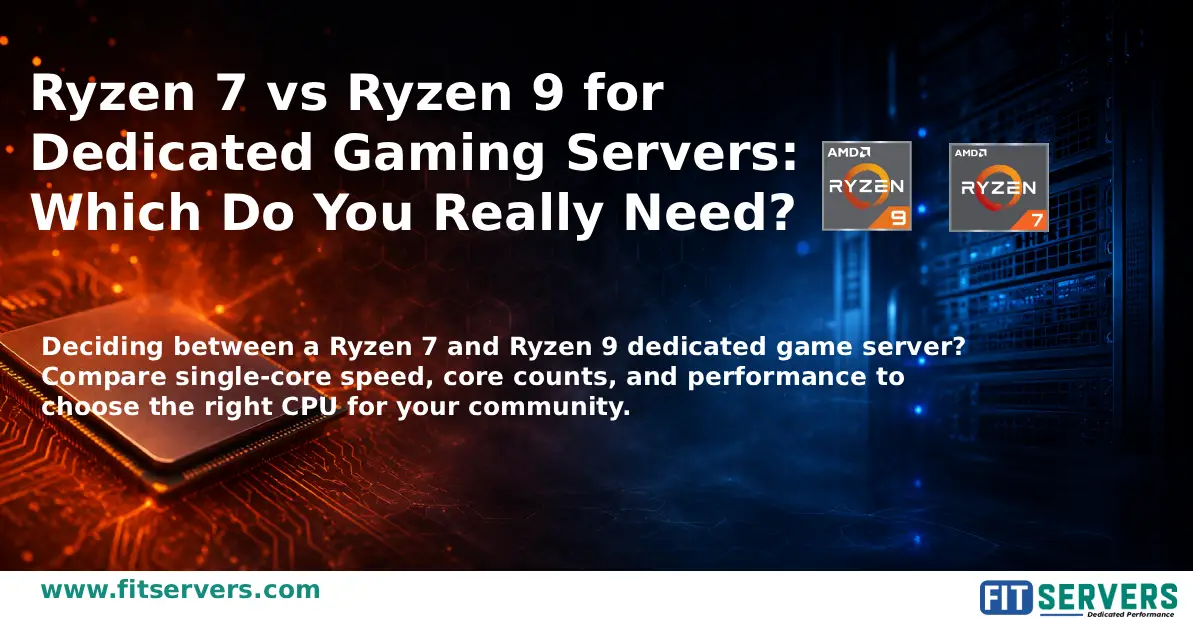
Whether you are building a machine to host a heavily modded Minecraft network, a massive Rust instance, or an ARK: Survival Evolved cluster, your CPU choice is the single most critical factor in keeping your server's tick rate stable and your players happy.
The short answer: For hosting a single, high-population game server, the Ryzen 7 (specifically X3D models like the 7800X3D or 9800X3D) is the better choice due to its unrivaled single-core performance and massive cache. However, if you plan to run multiple heavy server instances simultaneously on the same machine, the high core count of the Ryzen 9 (like the 7950X or 9950X) makes it the superior, heavy-duty workhorse.
Is the AMD Ryzen 7 or 9 Better for Gaming Servers?
To understand which CPU is better, you have to understand how game server software actually utilizes computer hardware. Desktop gaming (playing the game) and server hosting (running the game world) are two entirely different workloads.
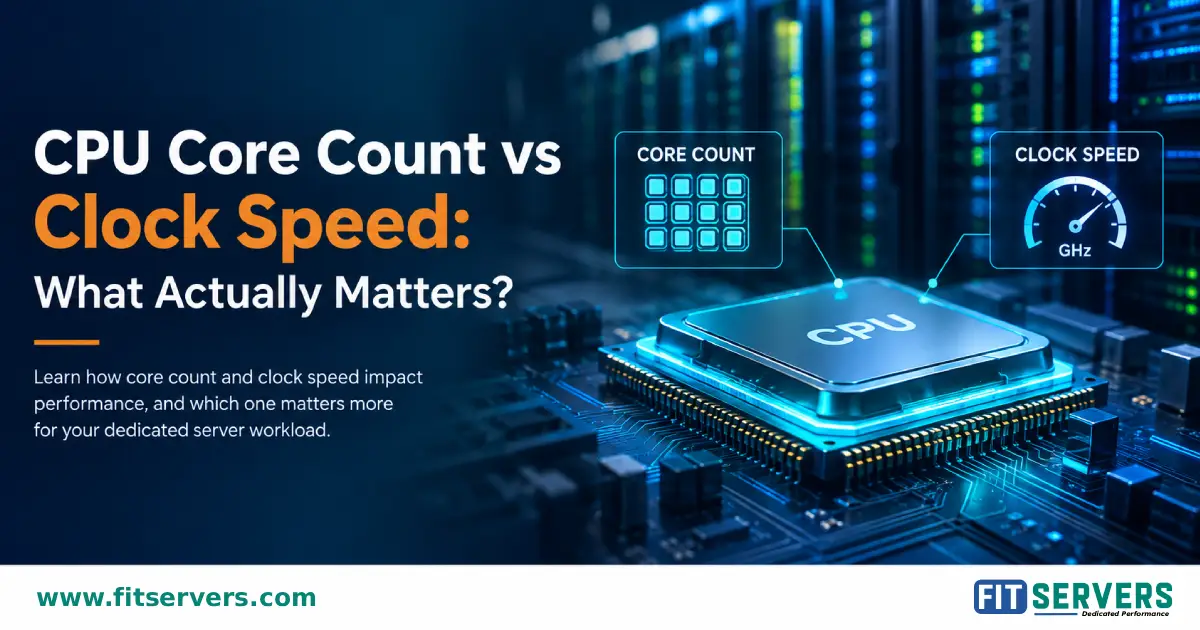
Most modern game engines—including the ones powering Minecraft, Palworld, and Valheim—are notoriously bound by single-threaded performance. This means the server software relies primarily on a single CPU core to calculate the game's main simulation loop: player movements, physics, entity AI, and block updates.
Ryzen 7 (The Sprinter)
8 ultra-fast cores built for raw engine speed.
- Ideal for single-threaded game engines
- Perfect for Minecraft or Rust
- Extremely high boost clocks (5.0+ GHz)
- Better price-to-performance ratio
Ryzen 9 (The Bodybuilder)
16 cores built for massive multi-tasking.
- Built for heavy multi-tasking workloads
- Host multiple instances on one machine
- Up to 16 physical cores / 32 Threads
- Prevents resource fighting between servers
The 3D V-Cache Game Changer
If you are looking at the AMD lineup, you will notice CPUs with an "X3D" suffix. These processors utilize AMD's 3D V-Cache technology. Instead of being limited to spreading the L3 cache out horizontally across the CPU die, AMD stacked additional cache vertically directly on top of the processor's silicon.
This results in massive cache sizes (up to 96MB on a Ryzen 7 9800X3D compared to 32MB on a standard chip). For game servers, this is a massive advantage. Server software constantly needs to retrieve small bits of entity data. Keeping that data on the CPU's cache rather than fetching it from the system RAM drastically reduces latency.
What is the Best CPU for a Dedicated Game Server?
The "best" CPU is entirely contextual to your hosting environment. Let's break down the ideal use cases based on real-world data from the Zen 4 (7000 series) and Zen 5 (9000 series) architectures.
If you are asking for raw, unadulterated power for a home lab or small commercial node, the AMD Ryzen 9 9950X3D takes the crown. It offers the high single-thread speeds required to keep game tick rates at a flawless 20 TPS, while offering 16 physical cores for massive multi-server clustering.
No. A dedicated game server does not need a dedicated GPU. Dedicated servers run "headless." They do not render graphics or textures. Divert every single dollar you would have spent on a graphics card into buying a better CPU, faster NVMe SSDs, and more RAM.
How much RAM do you need? Your CPU can only process data as fast as your memory can feed it. For a dedicated server running modern Ryzen chips, you must use DDR5 RAM. A Ryzen 7 Build (Single Server) typically needs 32GB of DDR5 RAM at 6000MHz. For a Ryzen 9 Build (Multi-Server), 64GB or 128GB of DDR5 is strictly necessary.
Real-World Game Engine Behavior
To truly utilize semantic keyword proximity and real-world context, we have to look at how specific games react to these processors.
The "Overkill" Debate: Do You Need That Much Power?
If you are only hosting one server for you and a dozen friends, yes, a Ryzen 9 is completely overkill. You will be paying a premium for 16 cores, but your game server will only use 2 to 4 of them. The remaining cores will sit idle, drawing extra power and generating heat.
However, if you are a community manager running a network—say, a lobby server, three Minecraft survival worlds, and a minigame server—a Ryzen 9 is exactly what you need.
| Feature | Ryzen 7 7800X3D | Ryzen 7 9800X3D | Ryzen 9 7950X | Ryzen 9 9950X3D |
|---|---|---|---|---|
| Architecture | Zen 4 | Zen 5 | Zen 4 | Zen 5 |
| Cores / Threads | 8 / 16 | 8 / 16 | 16 / 32 | 16 / 32 |
| L3 Cache | 96MB | 96MB | 64MB | 128MB |
| Max Boost Clock | Up to 5.0 GHz | Up to 5.2 GHz | Up to 5.7 GHz | Up to 5.7 GHz |
| TDP (Power) | 120W | 120W | 170W | 170W |
Frequently Asked Questions (FAQ)
Not at all. The Ryzen 7 line is continually updated. The Zen 4 (7000 series) and Zen 5 (9000 series) Ryzen 7 processors are currently some of the most advanced consumer CPUs on the market. They are the gold standard for mainstream gaming and dedicated server hosting.
No. The AMD Ryzen 9 directly competes with Intel's Core i9 line (like the Intel Core i9-14900K or Core Ultra 9 series). The AMD Ryzen 7 is the direct competitor to the Intel Core i7 line. Both the Ryzen 9 and Intel Core i9 represent the absolute top-tier, enthusiast-grade processors from their respective manufacturers.
If you are building a pure NAS (using software like TrueNAS to store files and run minor backups), both the Ryzen 7 and Ryzen 9 are massive overkill. A NAS relies primarily on hard drive speed and network bandwidth, not processing power.
Do you have a specific game engine in mind?
Whether you are looking to host a single Minecraft server on a blazing-fast Ryzen 7, or a massive ARK cluster spanning a multi-core Ryzen 9, we have the hardware for you.