The explosion of generative AI, real-time computer vision, and dynamic recommendation engines has shifted how engineering teams deploy machine learning. We are no longer just focused on training massive models in centralized data centers; AI inference is increasingly moving beyond centralized environments toward regional and edge deployments where low latency matters.
Real-time AI applications require low-latency responses, predictable performance, and the ability to process data physically close to where it is generated. But when it comes to deploying these models into production, CTOs, DevOps engineers, and startup founders face a critical architectural decision: Should you run edge AI inference on dedicated infrastructure, or use a serverless AI API?
This guide provides an objective, deep-dive comparison of both approaches exploring workload economics, latency, scaling, and data control-to help you determine the exact right infrastructure for your AI deployment.
What Is AI Inference?
Before comparing infrastructure, we must separate inference from training.
- Training is the computationally intensive process of teaching a machine learning model to recognize patterns by feeding it massive datasets across vast GPU clusters.
- Inference is the production phase. It is the process of using that already-trained model to make predictions, classifications, or decisions based on new, live input data.
The Flow: User Request → Deployed Model → Output (Prediction)
Training is typically performed as a separate model-development process, while inference uses the trained model to process new data in production. Depending on the model's size and the required speed, inference can run on CPUs (for smaller, lightweight models) or GPUs (for large language models or high-throughput computer vision workloads).
What Is Edge AI Inference?
Edge computing is the practice of moving compute resources physically and network-wise closer to the user or data source, bypassing distant, centralized cloud regions.
Edge AI inference means deploying your trained AI models near the source of interaction.
It is important to note that "the edge" does not always mean running a model directly on a physical IoT device (like a smart camera or a phone). A regional dedicated server located in a data center within the same city as your user base is a fundamental piece of edge architecture.
Common edge AI workloads include:
- Industrial Automation: Defect detection on a fast-moving factory assembly line.
- Autonomous Systems: Drones or robotics processing spatial data instantly.
- Interactive AI: Voice assistants or AI avatars that require conversational, sub-200ms response times.
- Healthcare: Analysis of medical imaging data at the hospital level, subject to applicable privacy, security, and regulatory requirements.
Why Latency Matters for AI Inference
A 500-millisecond delay may be acceptable in some traditional web applications, but latency-sensitive AI applications can have much tighter response requirements.
If an automated quality assurance system on a manufacturing line takes too long to infer that a part is defective, the part has already moved past the rejection mechanism. If an AI voice agent has a noticeable delay, the user experiences awkward, unnatural pauses.
Moving AI inference to the edge minimizes network round-trips. Instead of a user request traveling to a remote cloud region for processing and then returning with the response, the data is processed on a server locally.
Dedicated Servers for Edge AI Inference
Running AI workloads on a dedicated server means you lease bare-metal infrastructure entirely devoted to your application. You do not share the physical hardware, network interfaces, or PCIe lanes with any other tenants.
With a dedicated server, you gain extensive control over the environment:
- Predictable Resources: Dedicated high-core CPUs, NVMe storage, and network bandwidth.
- Hardware Choice: You choose the exact specs. Crucially, not all AI needs GPUs. For lightweight NLP or tabular data models, a high-frequency CPU server is often sufficient. For LLMs or high-throughput computer vision, you can provision specific GPUs.
- Software Control: Complete freedom to manage your inference runtime, containerization (Docker/Kubernetes), OS security, and libraries (CUDA, TensorRT, ONNX).
Serverless AI APIs Explained
Serverless AI APIs abstract the infrastructure layer. Instead of provisioning hardware, your application simply sends a payload to a third-party provider's API endpoint, and the provider routes it to their hosted AI model.
The Flow: Application → Internet/API Gateway → Provider Infrastructure → Model → Response
This approach eliminates server management, allows for rapid prototyping, and scales automatically. You generally pay a usage-based fee, such as cost-per-1,000-tokens or cost-per-request.
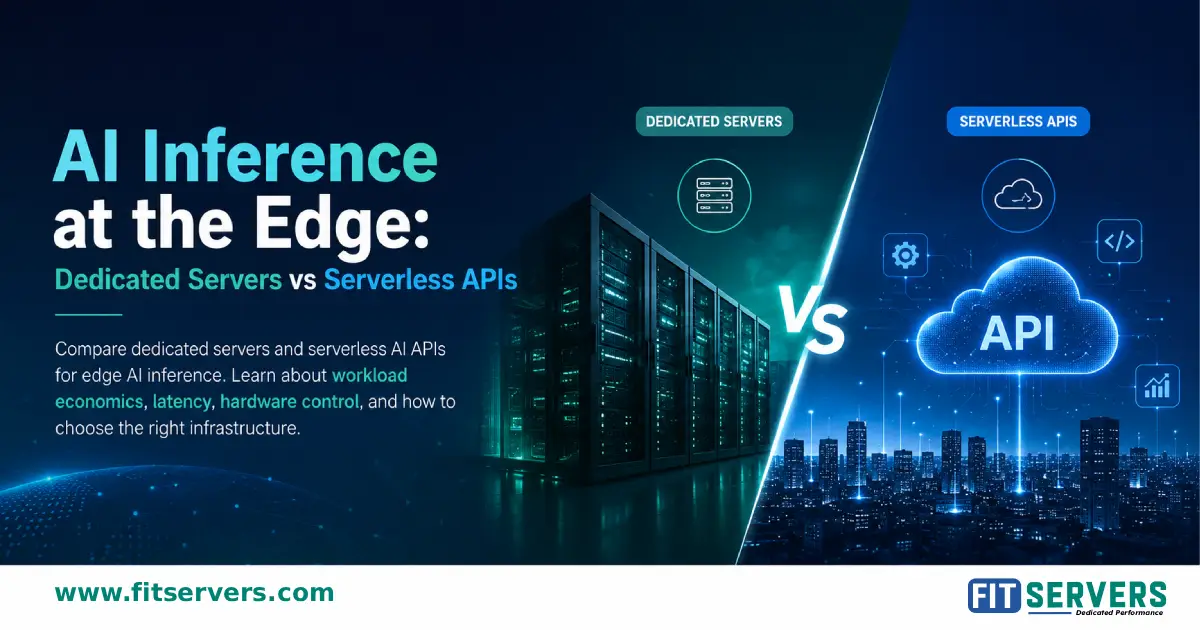
Dedicated Servers vs Serverless APIs
When deciding how to host your AI inference workloads, the right choice depends heavily on your team's capabilities and your application's traffic patterns.
| Feature | Dedicated Server | Serverless AI API |
|---|---|---|
| Hardware Control | High (Complete root access) | Low (Abstracted by provider) |
| GPU/CPU Choice | You select the exact hardware | Provider determines hardware |
| Scaling | You manage capacity & load balancing | Usually automatic |
| Performance Predictability | Generally high (No noisy neighbors) | Variable (Depends on provider load) |
| Pricing Model | Fixed monthly cost | Usage-based (Per request/token) |
| Data Control | Greater control over data processing | Depends on API provider's terms |
| Custom Models | Native support | Often limited or unsupported |
Performance and Latency
When building edge applications, the physical routing of data dictates performance.
Serverless Latency
Serverless APIs can introduce additional network and API overhead, and actual latency may vary depending on the provider's architecture, region, model size, and current workload. Your request must traverse the public internet, pass through the provider's API gateway, wait in an internal queue, process, and return.
Dedicated Edge Latency
With a dedicated edge server, you place the hardware physically close to the user. The routing is direct: Application → Local Edge Server → Model. By minimizing distance and network hops, dedicated infrastructure helps deliver the ultra-low, predictable latency required for real-time applications.
Furthermore, dedicated infrastructure allows for deep throughput optimization. Because the hardware is yours, you can fine-tune batching strategies, manage concurrent requests, and optimize GPU memory utilization without hitting external rate limits.
Cost and Workload Economics
The most common misconception in AI infrastructure is the blanket statement that "serverless is always cheaper." The reality is entirely dependent on workload economics and utilization rates.
When Serverless is Economically Attractive:
If your application has low, intermittent, or highly unpredictable usage, serverless APIs can be economically attractive. You are not paying for idle servers overnight, and you don't need a dedicated DevOps engineer to manage the infrastructure.
When Dedicated is Economically Attractive:
As your inference volume grows and stabilizes, the math flips. If your application runs continuously and maintains high CPU or GPU utilization, paying a toll for every single token or request quickly adds up. For high-volume, continuously utilized workloads, a dedicated server can offer a lower effective cost per inference than usage-based API pricing.
Data Privacy and Infrastructure Control
For enterprise edge AI workloads, data privacy, data residency, and compliance are often strict requirements.
Sending sensitive user data, PII (Personally Identifiable Information), or proprietary video feeds over the internet to a third-party API introduces security and compliance variables.
Deploying models on dedicated infrastructure provides an isolated environment and greater control over data processing. While a dedicated server doesn't automatically grant absolute security you still must configure proper OS access controls, firewalls, and application level security it ensures that data is processed on your terms, without passing through external analytics engines or third-party logging systems.
Custom AI Models and Runtime Optimization
If you are building specialized applications, you will likely outgrow general-purpose API models. You may need to deploy fine-tuned open-source models or entirely custom computer vision architectures.
- Serverless limitations: While some providers offer fine-tuning endpoints, support for highly customized models or bespoke inference runtimes is often restricted.
- Dedicated advantages: A dedicated server offers full root access. You can deploy any custom model, leverage quantization (reducing model precision to save RAM), and utilize hardware-specific optimizations like NVIDIA TensorRT or ONNX Runtime to squeeze maximum performance out of the silicon.
Scaling AI Inference
Serverless APIs win on effortless scaling. If your application goes viral, the provider handles the compute spike seamlessly.
Scaling dedicated infrastructure requires proactive capacity planning, but it is highly scalable. Teams manage scale by:
- Deploying multiple dedicated edge servers across different geographic regions.
- Placing servers behind load balancers.
- Using container orchestration (like Kubernetes) to manage multi-server CPU or GPU clusters.
Dedicated scaling isn't "zero-touch," but it provides resilient, globally distributed edge architectures without arbitrary API rate limits.
When Dedicated Servers Make Sense
Opting for a dedicated server is a strategic choice for mature, performance-critical workloads. Choose dedicated infrastructure when:
- Workload is consistent: You have a high and predictable volume of inference requests.
- Latency is critical: You need edge deployments to achieve real-time response times.
- Data requires strict control: You need complete oversight of where and how proprietary data is processed.
- Customization is required: You need to run custom models, quantized weights, or specialized runtimes.
- You need cost predictability: You want a flat monthly bill rather than volatile usage-based pricing at high scale.
When Serverless APIs Make Sense
Serverless architecture remains an excellent tool for specific scenarios. Choose a serverless API when:
- You are prototyping: Building an MVP or proof-of-concept.
- Traffic is highly variable: Usage is intermittent, unpredictable, or generally low.
- No DevOps resources: You do not have the engineering bandwidth to manage bare-metal servers or environments.
- Using proprietary models: Your application relies on closed-source foundation models that are only accessible via API.
Hybrid AI Inference Architecture
In the real world, the best architecture is rarely an absolute "A vs B." The most efficient systems often utilize a Hybrid Approach. For example, an application might route standard, low-volume text summarization tasks to a Serverless API, while routing real-time, high-volume computer vision tasks (or requests involving sensitive user data) to a local Dedicated Edge Server. This balances rapid development for secondary features with high performance and cost control for core AI workloads.
How to Choose the Right Infrastructure
To simplify your decision, use this quick framework:
- Do you need absolute control over the data processing environment? → Dedicated Server
- Are you building a quick MVP with zero DevOps support? → Serverless API
- Do you have high, consistent inference volume (continuous usage)? → Dedicated Server
- Is your inference volume very low or sporadic? → Serverless API
- Do you need highly predictable edge latency? → Dedicated Server
Fit Servers for Edge AI Inference
When your AI application outgrows the unpredictable latency and escalating costs of usage-based APIs, transitioning to dedicated infrastructure becomes a business necessity. Fit Servers provides the unshared, bare-metal foundation required to run continuous, high-volume AI inference at the edge without the vendor lock-in, rate limits, or hidden fees of serverless platforms.
By choosing Fit Servers, you gain absolute control over your hardware, data, and inference runtimes. We offer bare-metal dedicated servers tailored for a wide range of machine learning workloads. Depending on your model's requirements and our current inventory, you can configure high frequency CPU servers for lightweight inference, or deploy powerful Dedicated GPU Servers featuring architectures suited for high-throughput AI tasks.
With a growing global network of data center locations, Fit Servers allows you to deploy your infrastructure physically closer to your users, helping you achieve the ultra-low latency that edge AI demands. Combined with robust network connectivity and full root access, you get the isolated, dedicated environment necessary to run your AI applications securely and cost-effectively at scale.
(Note: Hardware availability, specific GPU models, and network capacities vary by location. Check our current inventory for exact specifications).