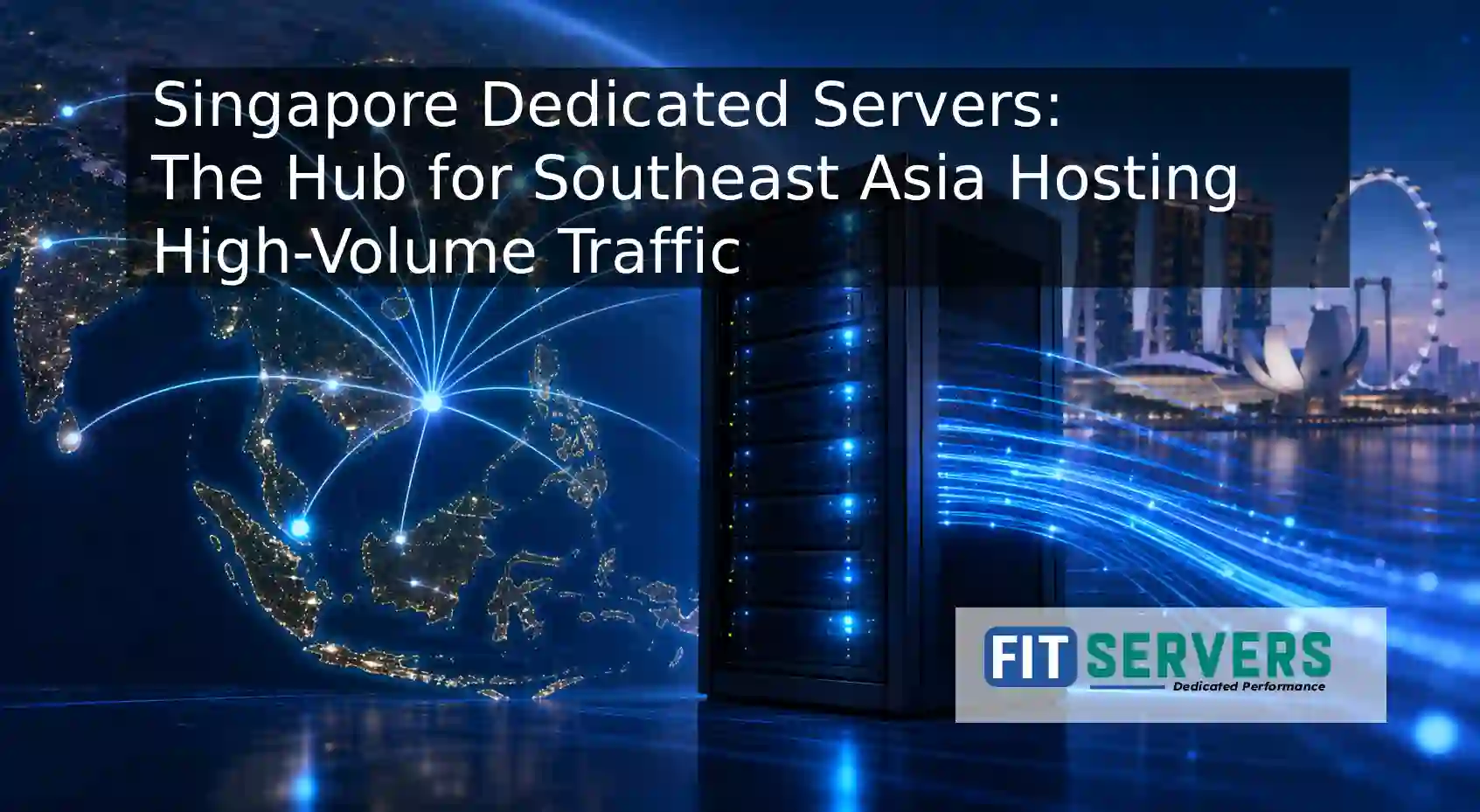
Singapore has emerged as the undisputed internet infrastructure hub of Southeast Asia, and for most APAC tech companies, it's not negotiable anymore. While smaller cities in the region offer cost advantages, none can match Singapore's submarine cable density, peering ecosystem, regulatory stability, or connectivity to global markets.
If you're scaling a SaaS platform, building e-commerce infrastructure, or deploying AI workloads across ASEAN, understanding Singapore's infrastructure position is critical to your infrastructure strategy.
01 The Submarine Cable Gateway: Singapore's 27-Cable Advantage
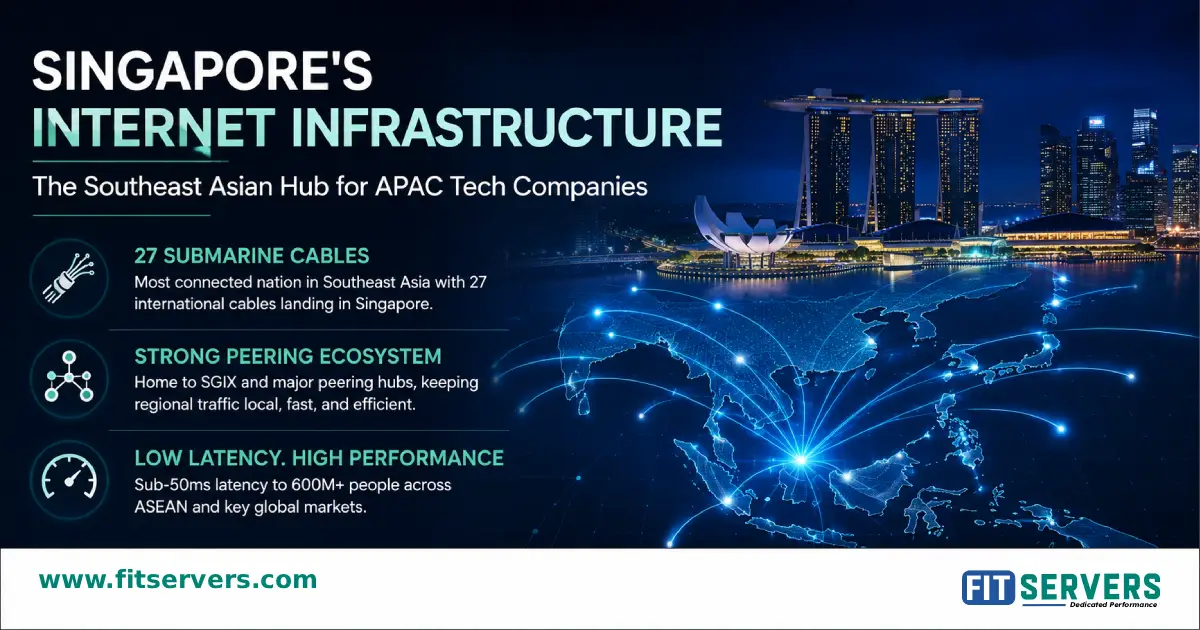
Singapore's dominance in APAC connectivity begins with one number: 27. That's how many international submarine cables currently land in Singapore, making it the most connected nation in Southeast Asia. Of the 97 international submarine cables operating across ASEAN, approximately 29% terminate in Singapore.
This concentration isn't accidental. It reflects decades of strategic port investment, regulatory clarity, and geographic position. Singapore sits at the maritime crossroads where traffic from Australia, India, Europe, and North America converges with regional ASEAN routes.
This isn't just redundancy for its own sake. When applications span multiple ASEAN nations, a single cable failure in Jakarta shouldn't take down your entire platform. Singapore's 27-cable ecosystem lets traffic reroute through alternate paths within milliseconds.
With 36 more cables planned across ASEAN through 2027, most new landings will again be in Singapore — meaning faster-growing capacity, built-in redundancy, and lower transit costs from cable competition.
02 Internet Exchange Points: Where Regional Traffic Stays Local
Most international traffic travels on submarine cables between continents. But regional traffic — between Indonesia and Thailand, or Malaysia and the Philippines — doesn't need to go offshore. That's where Internet Exchange Points (IXPs) matter.
Singapore hosts SGIX (Singapore Internet Exchange) and multiple private peering facilities operated by Equinix, Digital Realty, and other major data center operators. The city functions as a peering hub where networks across APAC exchange traffic locally, keeping data paths short and latency low.
When a user in Jakarta accesses a site hosted in Singapore, that traffic peers directly at SGIX instead of crossing an international cable and back — completing the round trip in single-digit milliseconds instead of tens of milliseconds. Major CDNs including Cloudflare, Akamai, and Fastly all maintain significant presence in Singapore, ensuring cached content is served with minimal network hops.
03 Latency Performance: The Numbers That Matter
APAC tech companies ultimately care about one metric: how fast does traffic reach users? Singapore delivers sub-50 millisecond latency to over 600 million people in Southeast Asia, and reaches more than 2 billion internet users across the broader APAC region within 100 milliseconds.
| Destination | Latency | Primary Use Cases |
|---|---|---|
| Jakarta | 30–40ms | Same-day delivery logistics, mobile payments |
| Bangkok | 35–45ms | Streaming, real-time collaboration |
| Manila | 40–50ms | Web applications, e-commerce |
| India | 40–70ms | South Asia connectivity |
| Sydney | 50–70ms | Australia and Oceania access |
| Tokyo | 65–80ms | Northeast Asia access from a SE Asia hub |
These latency bands matter for specific applications: sub-100ms for e-commerce checkouts to prevent abandonment, sub-200ms for payment processing to avoid doubt about transaction success, and sub-50ms for real-time collaboration, video conferencing, and multiplayer gaming.
04 Hyperscaler Investment: The Proof of Strategic Importance
AWS, Google, and Microsoft didn't choose Singapore arbitrarily. Combined, their recent commitments exceed US$20 billion in announced capital expenditure across the region.
Committed SG$12 billion to expand its existing Singapore infrastructure between 2024 and 2028.
Invested a cumulative US$5 billion in Singapore, plus a further US$2 billion pledged for its first Malaysian data center and cloud region.
Committed US$2.2 billion for Malaysia and US$1.7 billion for Indonesia through 2028 — markets that surround and support Singapore's core hub.
This isn't cost-minimization. AWS could build cheaper data centers in Thailand or Cambodia. The premium reflects Singapore's position directly at the submarine cable gateway, the internet exchange hub, close to regional enterprise headquarters, and within a mature regulatory framework — creating a virtuous cycle where hyperscaler expansion attracts more enterprises, which attracts more infrastructure investment.
05 Regulatory Stability: Why Singapore, Not Hong Kong
Five years ago, Singapore and Hong Kong were comparably attractive. Today they aren't. Regulatory changes in recent years have introduced uncertainty around data handling and content hosting in Hong Kong, while Singapore offers a more stable and predictable environment combined with comparable or better connectivity to most APAC markets outside mainland China.
Personal Data Protection Act (PDPA)
Aligned with GDPR standards and recognized internationally, giving global companies a familiar compliance baseline.
Monetary Authority of Singapore (MAS)
Clear financial services regulation that fintech and payments companies can build against with confidence.
Stable Legal Framework
A common law tradition with predictable contract enforcement reduces legal risk for long-term infrastructure investment.
No Geographic Data Restrictions
Unlike some regional alternatives, Singapore has no mandatory local storage requirements for foreign firms.
06 The Geographic Reality: Why Alternatives Don't Compete
Other APAC cities have invested heavily in data center infrastructure. None have successfully challenged Singapore's position.
Hong Kong
Excels at serving greater China, Taiwan, and Korea, but sits 50–80ms from most Southeast Asian cities — better as a secondary region than a primary SE Asia hub.
Sydney
Optimal for Australia and New Zealand, but 100+ milliseconds from Jakarta makes it impractical as a regional hub for Southeast Asia.
Thailand
Offers lower cost and tax incentives, including an eight-year corporate income tax exemption and low-latency access to Vietnam and Malaysia — but infrastructure is still less mature than Singapore's.
Malaysia (Johor)
Benefits from terrestrial fiber links directly into Singapore's cable infrastructure, offering Singapore-grade connectivity at Malaysian operating costs — a cost play, not a redundancy option.
07 Practical Infrastructure Considerations
Network architecture: Carrier-neutral data centers offer dense interconnection to SGIX, Equinix IX, cloud providers, and regional partners from a single facility, reducing total cost of ownership and avoiding lock-in to one provider's network.
Power and sustainability: Under Singapore's Green Plan 2030, facilities offering renewable energy procurement, efficient cooling, and PUE transparency help enterprises align with ESG goals and upcoming compliance measures.
Redundancy strategy: Singapore's cable diversity and peering density make it ideal as primary infrastructure. Common redundancy pairings include Singapore + Hong Kong for SE Asia and Northeast Asia coverage, Singapore + Sydney for Australia/Oceania, and Singapore + India for South Asia.
08 Making the Infrastructure Decision
Singapore isn't the cheapest APAC option, but the equation shifts once you factor in cable diversity, peering access, latency advantage, and regulatory clarity. Here's how the decision typically breaks down:
Singapore is the default choice. Any other location introduces a latency penalty without offsetting benefits.
Use Singapore as primary infrastructure with dual-region deployment to Japan or Hong Kong for redundancy.
Consider Thailand or Malaysia as cost-efficient alternatives if the latency penalty is acceptable, and plan to migrate to Singapore as you scale.
Singapore is non-optional. The regulatory framework and infrastructure maturity justify the premium.
Singapore's internet infrastructure dominance isn't a temporary advantage. It's structural — built on submarine cable diversity, internet exchange density, regulatory clarity, and massive hyperscaler investment. It will persist through 2030 and beyond.
FAQ Frequently Asked Questions
Why is Singapore considered the internet infrastructure hub of Southeast Asia?
How many submarine cables land in Singapore?
What latency can APAC companies expect from Singapore?
How much have hyperscalers invested in Singapore infrastructure?
Is Singapore more expensive than other APAC hosting locations?
Should startups use Singapore or cheaper alternatives like Thailand and Malaysia?
Ready to Deploy in Singapore?
Fit Servers offers bare metal servers with direct access to SGIX peering, submarine cable infrastructure, and low-latency connectivity across ASEAN — whether you're running SaaS, fintech, or regional cloud infrastructure.