Graphics processing has become an important part of modern computing. From displaying desktop interfaces and rendering videos to powering artificial intelligence applications, scientific simulations, and high-performance computing workloads, GPUs handle tasks that benefit from parallel processing.
However, not every computer or server requires the same type of graphics hardware. Some AMD processors include Radeon integrated graphics (iGPU), while other systems rely on a separate graphics card known as a dedicated or discrete GPU.
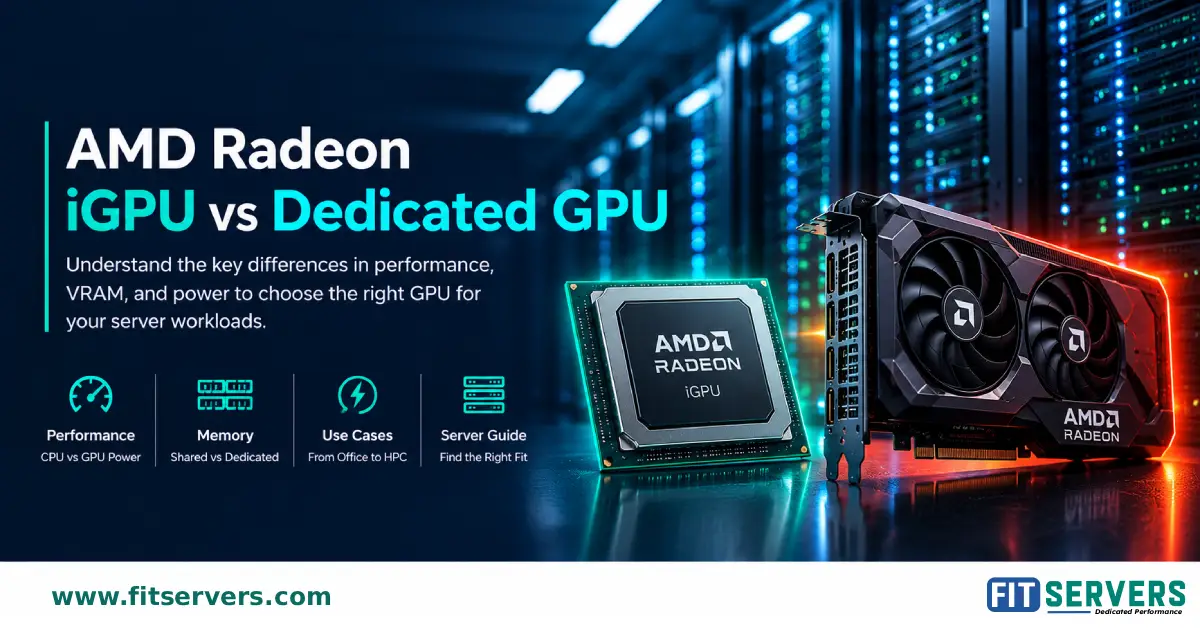
Although both technologies perform graphics-related operations, their hardware architecture, memory configuration, processing capabilities, and intended workloads differ significantly. Understanding AMD Radeon iGPU vs Dedicated GPU is particularly important when selecting hardware for professional applications, virtualization environments, GPU computing, and dedicated server deployments.
While an integrated Radeon GPU can be sufficient for basic display output and lightweight graphics processing, a dedicated GPU provides separate processing resources and dedicated video memory, making it suitable for demanding graphics and compute-intensive workloads. This guide explores how these two GPU configurations work, their technical differences, practical applications, and how to determine which option is appropriate for your specific computing and server requirements.
01 What Is AMD Radeon Integrated Graphics (iGPU)?
An integrated GPU, commonly called an iGPU, is a graphics processing unit built directly into the processor package rather than installed as a separate graphics card. AMD processors that feature built-in Radeon graphics are historically and commonly referred to by the company as APUs (Accelerated Processing Units).
AMD incorporates Radeon graphics into several Ryzen desktop and mobile processors. Depending on the processor generation and model, these integrated graphics solutions use different Radeon architectures and configurations. For example, certain AMD Ryzen processors include Radeon 610M, Radeon 680M, Radeon 760M, and Radeon 780M integrated graphics.
How Does an AMD Radeon iGPU Work?
An integrated Radeon GPU shares system resources with the CPU. Its operation relies on three main components:
- Shared System Memory: The integrated GPU uses system RAM for graphics operations instead of relying on dedicated memory.
- Integrated Processing Architecture: The graphics hardware is incorporated directly into the processor platform, eliminating the need for a separate PCIe graphics card.
- Shared Power and Thermal Resources: The CPU and integrated graphics operate within the platform's overall power and thermal limits, making integrated graphics highly power-efficient for basic tasks.
Common Uses of AMD Radeon iGPUs
AMD Radeon integrated graphics are commonly suitable for:
- Desktop interfaces and operating system display output.
- Office applications and general productivity.
- Video playback and media decoding.
- Lightweight photo editing and basic graphical applications.
- Development environments that do not require substantial GPU acceleration.
For many standard computing environments, integrated graphics provide sufficient functionality. However, their shared memory architecture and comparatively limited processing resources can become constraints when applications require substantial GPU performance.
02 What Is a Dedicated GPU?
A dedicated GPU, also known as a discrete GPU (dGPU), is a separate graphics processing unit installed independently of the CPU. Unlike integrated graphics, a dedicated GPU typically has its own graphics memory, processing architecture, power delivery, and cooling requirements.
AMD offers dedicated graphics products under its Radeon RX (consumer) and Radeon PRO (professional) product families. These GPUs are designed for workloads ranging from high-end gaming and content creation to professional visualization and GPU-accelerated computing.
How Does a Dedicated GPU Work?
A dedicated GPU operates independently of the CPU's integrated graphics resources, utilizing three important components:
- Dedicated Video Memory (VRAM): A dedicated graphics card has its own video memory, physically separate from the system RAM.
- Independent Processing Resources: Dedicated GPUs contain their own graphics processing units, compute units, memory controllers, and supporting hardware designed to execute large numbers of parallel operations efficiently.
- Separate Power and Cooling Requirements: A dedicated GPU normally receives power through the motherboard PCIe slot and additional power connectors, requiring appropriate cooling and sufficient chassis airflow to operate at high performance levels.
Common Uses of Dedicated GPUs
Dedicated GPUs are suitable for more demanding applications, including high-resolution 3D rendering, professional video production, GPU-accelerated engineering and simulation, machine learning and AI inference, parallel computing, GPU-enabled virtualization, and high-performance data processing.
03 AMD Radeon iGPU vs Dedicated GPU: Key Differences
Although both GPU types can process graphics instructions, their hardware configurations are substantially different.
| Feature | AMD Radeon iGPU | Dedicated GPU |
|---|---|---|
| Hardware configuration | Integrated into the processor platform (APU) | Separate graphics card |
| Memory | Shared system RAM | Dedicated VRAM |
| Memory bandwidth | Depends on system memory configuration | Depends on GPU memory technology/configuration |
| Processing resources | Generally more limited | Varies from entry-level to high-performance |
| Power consumption | Usually lower | Generally higher |
| Cooling requirements | Shares platform cooling | Requires appropriate GPU cooling |
| Installation | Included with specific processors | Requires compatible hardware and PCIe slots |
| Upgrade options | Tied to processor/platform | Can often be upgraded independently |
| Heavy rendering | Limited by available resources | Better suited to demanding workloads |
| AI computing | Limited and software-dependent | Depends on GPU architecture and software |
| Server applications | Basic display and lightweight tasks | GPU-accelerated workloads |
04 Memory Architecture: Shared RAM vs Dedicated VRAM
Memory architecture is one of the most important differences between integrated and dedicated graphics. It directly affects how much data a GPU can process and how efficiently it can access that data.
AMD Radeon iGPU: Shared System Memory
An integrated Radeon GPU uses system memory through a Unified Memory Architecture (UMA). The operating system and CPU applications also need access to that same memory.
While the GPU may have an allocated UMA frame buffer, that allocation is not physically dedicated VRAM. However, it is worth noting that system administrators can often manually allocate a static chunk of system RAM to the iGPU via the motherboard BIOS. While physically still system RAM, the operating system treats this allocation exactly like dedicated VRAM, making it inaccessible to the CPU. Ultimately, the available graphics memory and performance depend heavily on this BIOS configuration, system RAM speed, and the platform.
Dedicated GPU: Independent Video Memory
A dedicated graphics card contains its own VRAM. For example, an AMD Radeon PRO graphics card with 32GB GDDR6 has 32GB of physically dedicated graphics memory with its own high-speed memory bandwidth.
This advantage becomes particularly important when processing large textures and 3D assets, high-resolution video frames, large computational datasets, and neural network models. A dedicated GPU with sufficient VRAM can process workloads that easily exceed the practical memory capabilities of an integrated graphics solution.
05 Performance Differences: Which GPU Is More Powerful?
In most demanding graphics and compute-intensive applications, a dedicated GPU offers substantially greater performance than an integrated GPU.
Integrated GPU Performance
AMD Radeon integrated graphics have improved considerably across processor generations. Modern integrated solutions, such as the Radeon 780M, are highly capable and can handle everyday graphics operations, video workloads, and lightweight gaming. Nevertheless, they remain constrained by shared system memory and the physical space available on the CPU die.
Dedicated GPU Performance
Dedicated GPUs are designed to handle larger and more demanding workloads. Depending on the model, they provide more compute units, higher memory bandwidth, and larger dedicated VRAM capacity. For example, the AMD Radeon PRO W7900 offers 48GB of GDDR6 memory and a 384-bit memory interface. This fundamentally different hardware configuration makes a dedicated GPU the appropriate option for professional rendering, visualization, and compute-heavy applications.
06 Power Consumption and Cooling Requirements
Power efficiency is another critical consideration, particularly in data centers and server racks.
Integrated Graphics: An integrated GPU shares the processor's power and cooling resources. It does not require a separate graphics card or additional power connectors, making it a practical option for servers that primarily perform CPU-based tasks and prioritize power efficiency.
Dedicated Graphics: A dedicated GPU has strict power and thermal requirements. It may require additional PCIe power connectors, a higher-capacity power supply, and massive chassis airflow. Before selecting a dedicated GPU server, administrators must verify physical dimensions, power delivery, cooling compatibility, and PCIe connectivity.
07 iGPU vs Dedicated GPU for Dedicated Servers
The difference between integrated and dedicated graphics becomes especially important in server environments, which are frequently designed to prioritize CPU performance, memory capacity, and network reliability over graphics.
When Is an Integrated GPU Sufficient for a Server?
An AMD processor with integrated Radeon graphics is ideal when the server handles strictly CPU-based workloads:
- Web Applications and Databases: Most conventional web operations rely on CPU, RAM, and storage. A dedicated graphics card adds no meaningful benefit.
- Development and Testing: Lightweight application deployments generally do not require powerful graphics hardware.
- Basic Remote Administration: Integrated graphics provide display output for administrative tasks (though remote management like IPMI operates independently).
- CPU-Based Virtualization: Many virtual machines do not require graphics acceleration.
When Does a Server Need a Dedicated GPU?
Dedicated GPU hardware becomes essential when applications depend on parallel processing:
- AI and Machine Learning: Neural network inference and model training operations benefit massively from dedicated GPU memory and compute architecture.
- 3D Rendering and Visualization: Professional applications use dedicated GPU resources to process complex visual data.
- Video Processing: Hardware encoding and decoding for streaming or video production.
- GPU-Accelerated Virtualization: Allowing multiple virtual machines to tap into partitioned GPU resources.
- Scientific and Engineering Applications: Parallel mathematical operations in simulation and research.
08 GPU Computing, AI Workloads, and Software
A common misconception is that every dedicated GPU automatically supports every AI or GPU-computing application. Software compatibility is a critical part of GPU selection.
For AMD GPUs, the ROCm software platform provides GPU computing capabilities. However, ROCm compatibility depends on the specific GPU model, operating system, driver, and application framework. An integrated Radeon GPU should not be assumed to support the same compute workloads or software configurations as an enterprise-grade dedicated AMD accelerator.
When selecting hardware for AI or machine learning, administrators must evaluate:
- GPU architecture and VRAM.
- Memory bandwidth and compute operations.
- Software framework compatibility.
- Driver and OS support.
Selecting a GPU server must begin with the software and workload requirements, rather than simply buying a card with a large memory capacity.
09 Practical Examples
Consider the following two hypothetical server configurations based on workload requirements:
Configuration A: AMD Ryzen APU (iGPU)
- AMD Ryzen processor with integrated Radeon graphics.
- 64GB DDR5 system memory.
- NVMe SSD storage.
- Standard server networking.
Use Case: Suitable for CPU-based application hosting, development environments, and general server administration.
Configuration B: Server with Dedicated GPU
- High-performance AMD EPYC server processor.
- 128GB or more system memory.
- Dedicated AMD Radeon PRO GPU with independent VRAM.
- NVMe storage & High-speed networking.
- Upgraded power delivery and cooling.
Use Case: Suitable for AI inference, GPU computing, professional visualization, and graphics-intensive workloads.
10 How to Choose & Final Verdict
Choosing between integrated and dedicated graphics should be based on the actual workload rather than defaulting to the most expensive hardware.
If the server runs web applications or databases, integrated graphics are sufficient. If it requires AI inference or rendering, evaluate dedicated GPU options.
Applications processing massive datasets require the substantial dedicated video memory found only on discrete GPUs.
Confirm that the specific GPU model is compatible with your required software framework (like ROCm) and operating system.
Ensure the server chassis can physically and thermally accommodate a dedicated GPU.
Can an Integrated GPU Replace a Dedicated GPU?
In some situations, yes. An integrated Radeon GPU can replace a dedicated graphics card for basic display output, everyday operations, and certain lightweight applications. Modern integrated graphics can even handle tasks that previously required entry-level discrete cards.
However, integrated graphics are not a universal replacement. They lack the VRAM capacity, compute units, and memory bandwidth required by demanding professional workloads. If a server's workload does not use GPU acceleration, investing in a separate graphics card simply adds unnecessary hardware costs and power draw. The best configuration is the one tailored strictly to the application's needs.
Final Verdict
AMD Radeon integrated graphics and dedicated GPUs serve distinctly different purposes. An integrated GPU (APU) is a practical, power-efficient solution for systems that need basic graphics functionality without the overhead of additional hardware. A dedicated GPU provides separate processing resources and independent VRAM, making it the required choice for demanding graphics applications, professional visualization, AI workloads, and GPU-accelerated computing.
For dedicated server deployments, the decision rests entirely on whether the applications benefit from GPU acceleration. Ultimately, the right choice comes down to workload requirements, memory capacity, software compatibility, and power availability.
FAQ Frequently Asked Questions
What is the main difference between AMD Radeon iGPU and a dedicated GPU?
Is AMD Radeon integrated graphics good for everyday computing?
Does an AMD Radeon iGPU have dedicated VRAM?
Is a dedicated GPU better for AI workloads?
Can a server run without a dedicated GPU?
Can AMD Radeon integrated graphics handle gaming?
What is the advantage of dedicated VRAM?
Are all AMD Radeon dedicated GPUs suitable for servers?
Power Your Workloads with the Right GPU Server
Selecting the right server hardware is essential. At Fit Servers, we provide dedicated server solutions designed for a wide range of computing requirements, including advanced GPU-powered environments.